
Hyo-Chong Yoo: A Life in Realism — SaMoGok Exhibition (思母曲)
Introduction
Curated by Isabel Lee — Online Exhibition
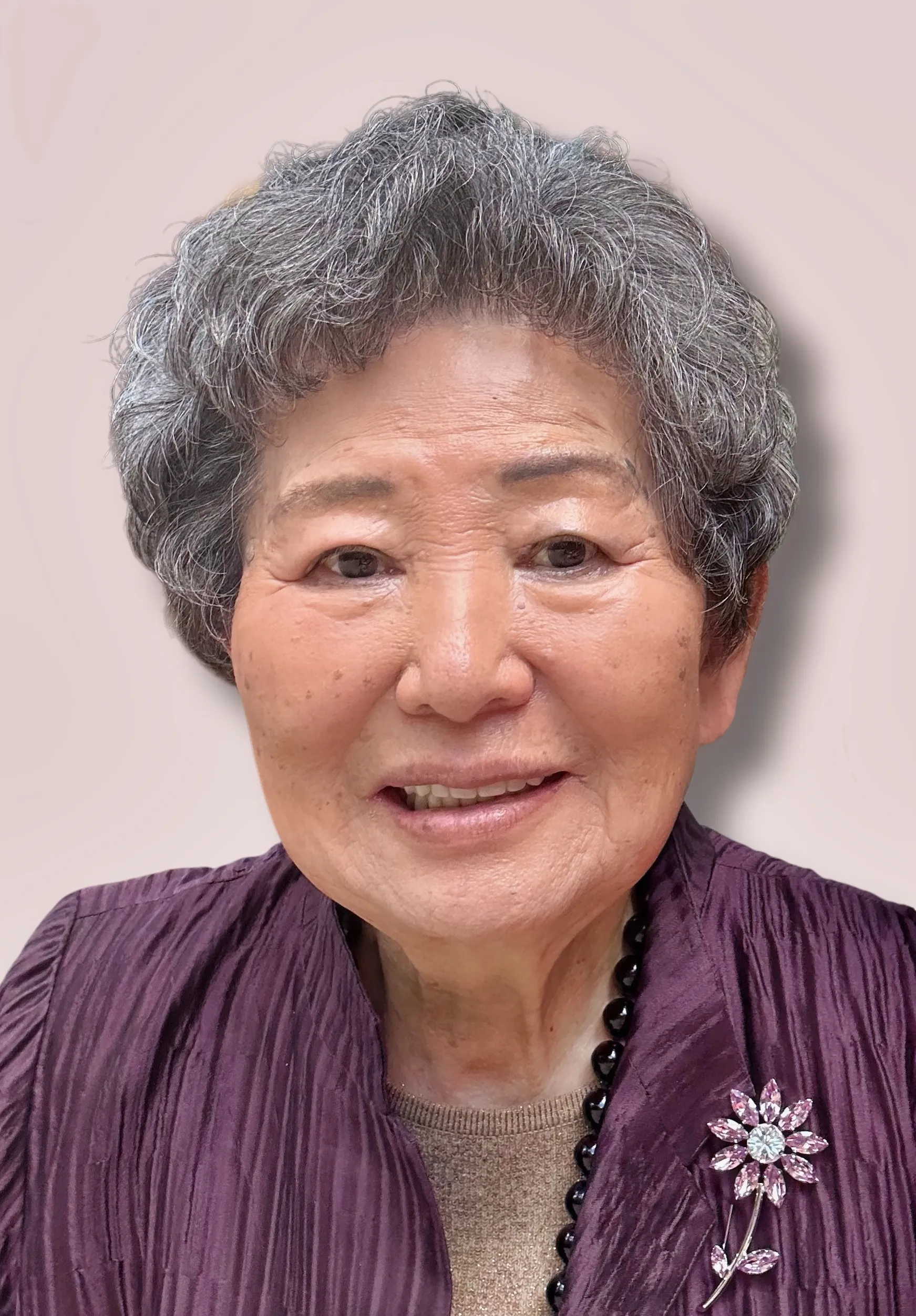
This exhibition presents a chronological and thematic study of the work and personal history of Hyo‑Chong Yoo (b. 1937), a Korean-American artist whose realism is grounded in discipline, intellect and expressive depth.
SaMoGok, the title of this exhibition, is a lyric piece from Korea’s Goryeo Dynasty about the primacy of and longing for maternal love. A constant figure in Yoo’s life, her mother became the guiding muse for many of her paintings. In these paintings, SaMoGok stands not only as a tribute to her mother and to maternal devotion more broadly, but also as a meditation on her Korean homeland and to the enduring resilience that underlies human experience.
Growing Up
“My father was a man of conviction and compassion. He founded an agricultural school to educate poor farmers and secretly taught women to read Korean when it was forbidden. For that, he was imprisoned. . . From him I learned that every stroke matters, that each line must carry life. His sense of moral purpose—the belief that sincerity is the soul of art—became my foundation.” – Hyo Chong Yoo
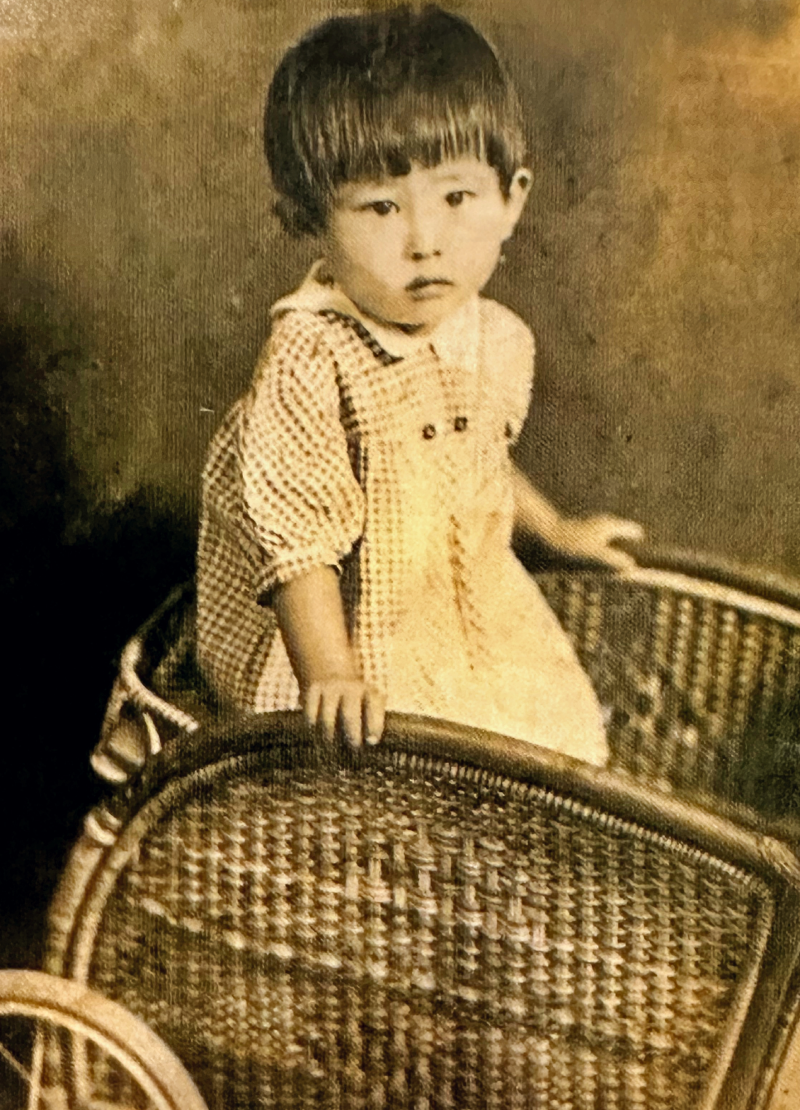
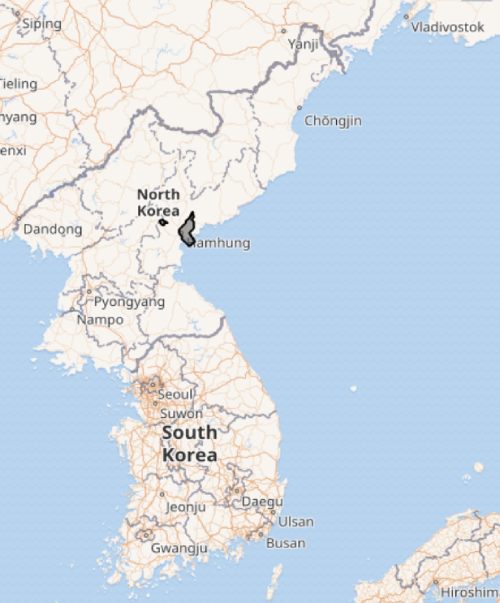
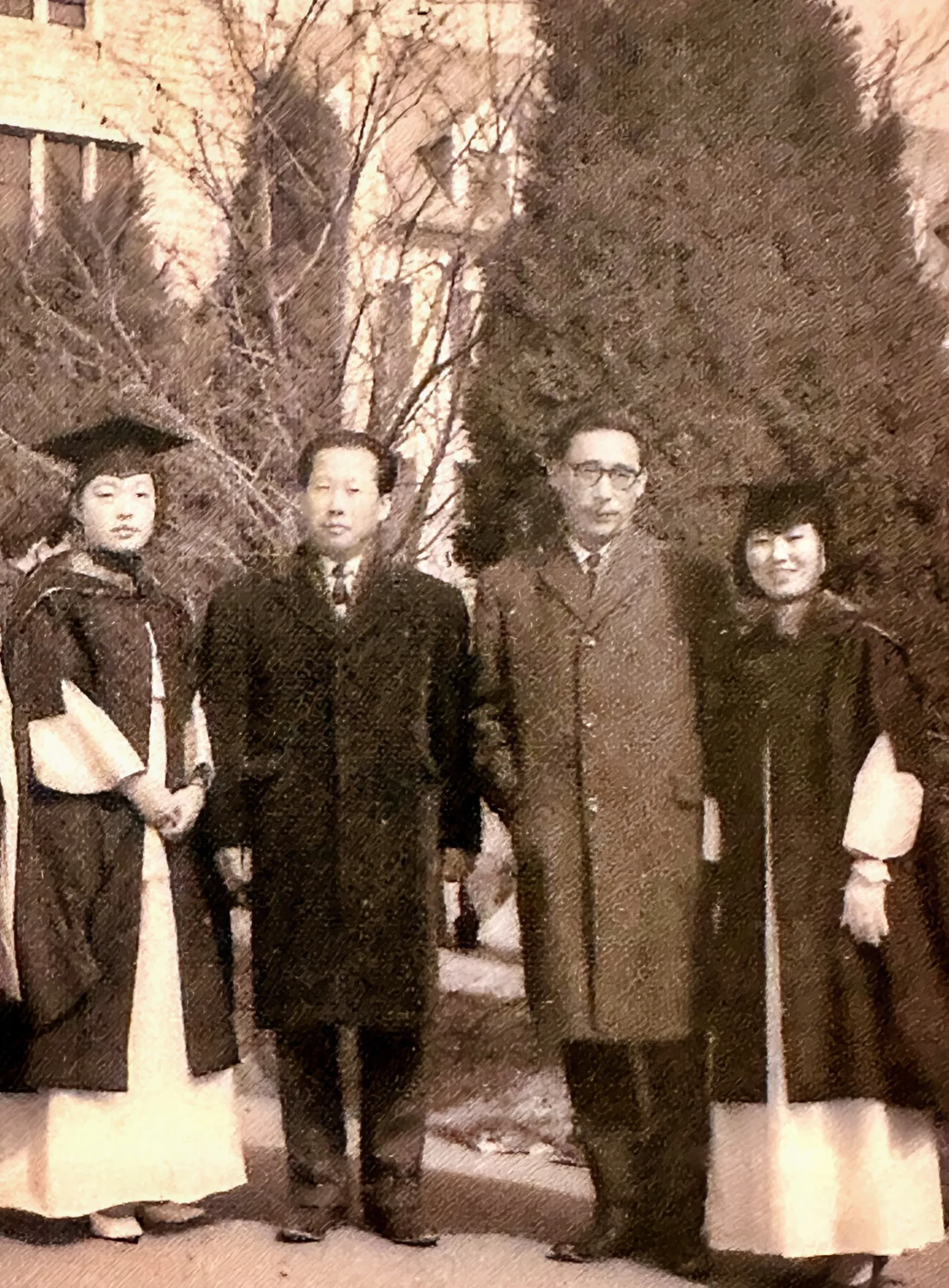
Born in 1937 in Hamhung (what is now North Korea) during the Japanese occupation of Korea, Yoo’s artistic formation was shaped by war, exile, and discipline. Her father, Yoo Dong‑Sun, was an independence fighter and a scholar-artist, skilled in painting and calligraphy. He taught her to grind ink on an inkstone, telling her to kneel and compose her mind before every stroke, a ritual that became the spiritual foundation of her realism.
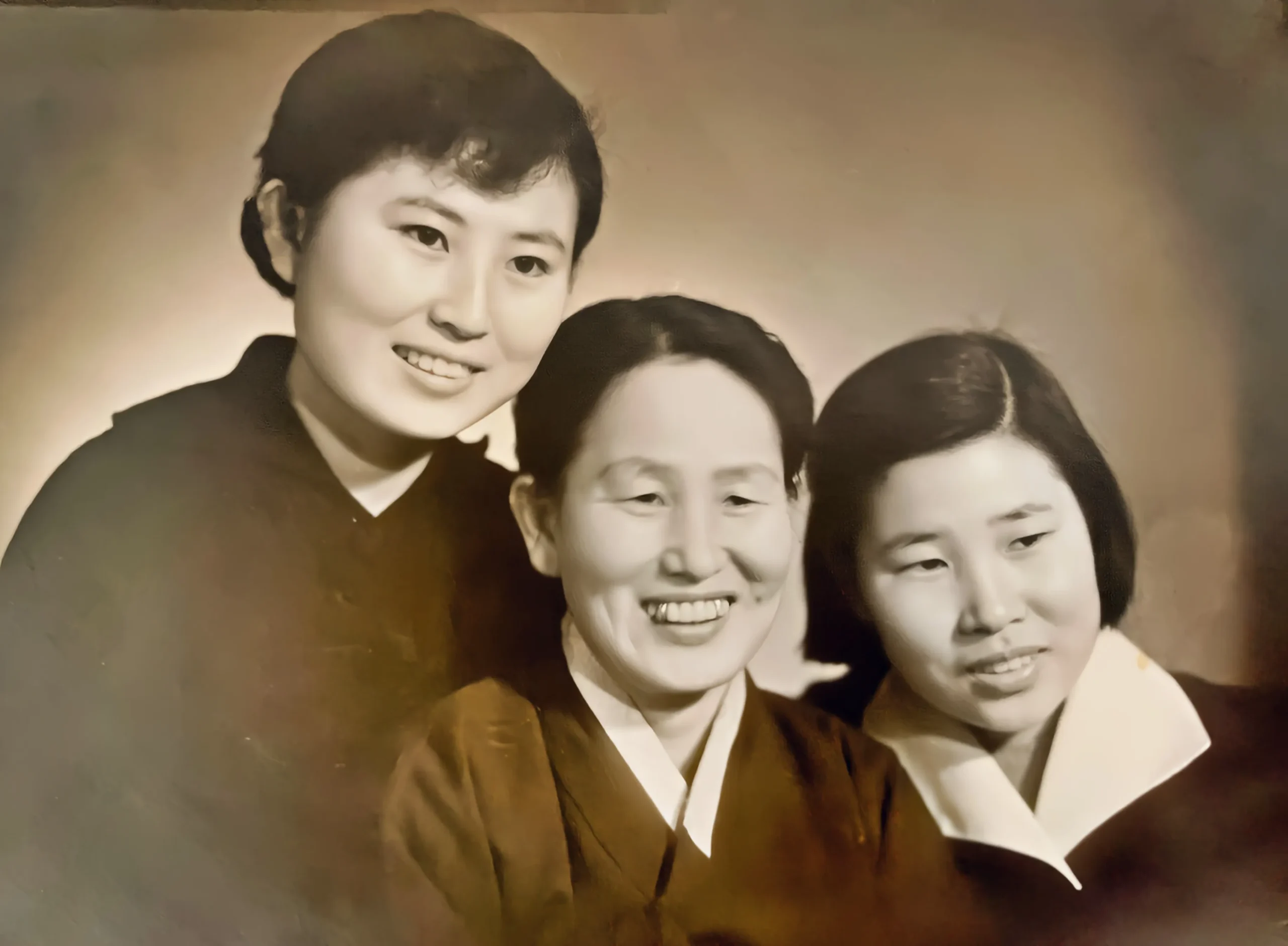
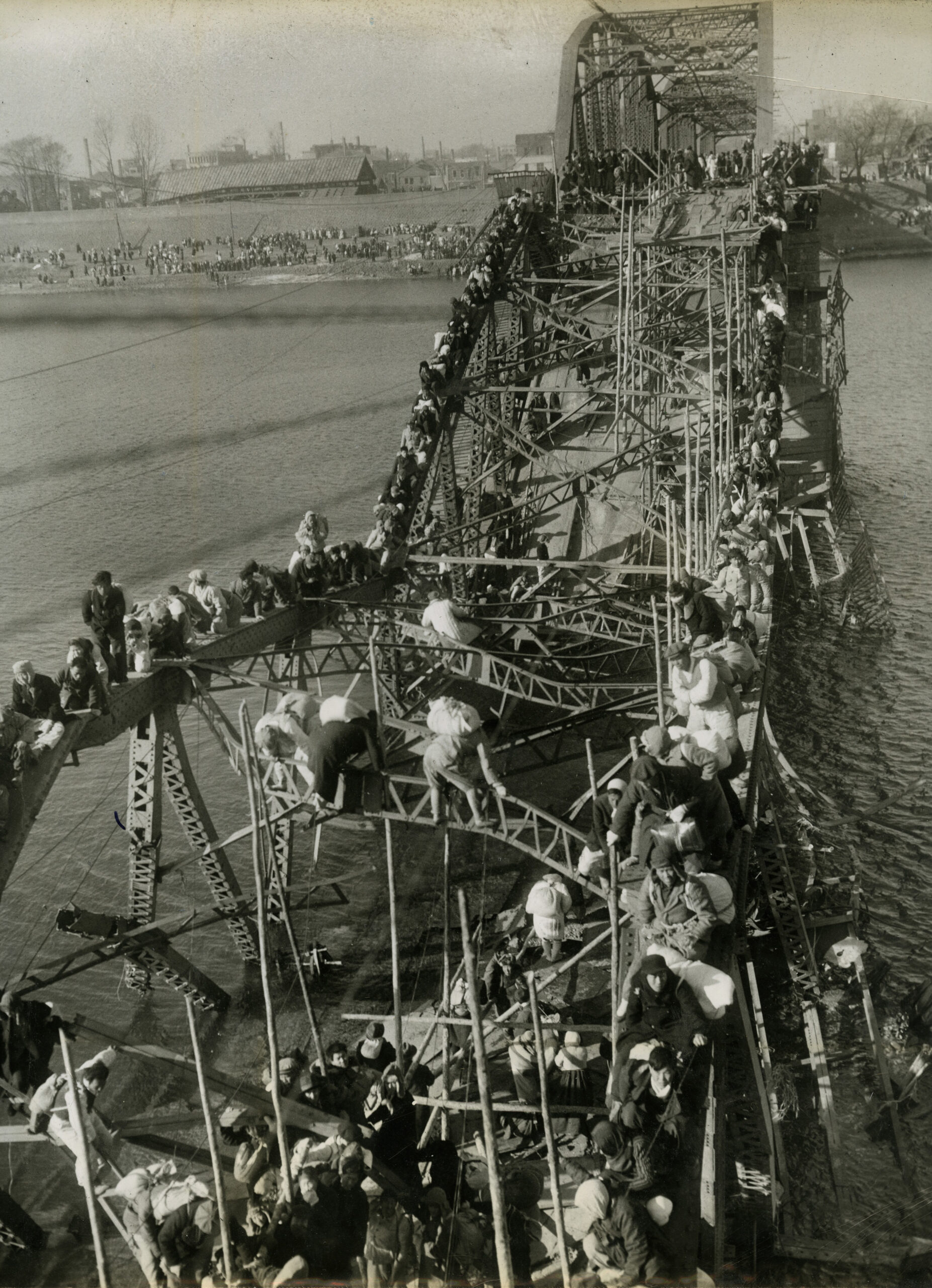
Her mother, Kim Kwan-Sum, came from a notable Hamgyŏng Province family, whose members included her cousin Kim Kyu-sik, a major architect of Korea’s government-in-exile in Shanghai. After becoming widowed at 32, Yoo’s mother carried her three young daughters across the 38th parallel in 1946 to escape the Soviet controlled North, traversing the shattered planks laid over the Imjin River railroad tracks, with the blue river water flowing beneath them. Through that perilous passage and the years of hardship that followed, Yoo’s mother raised the daughters with resilience, teaching endurance and humility even in the face of upheaval and loss.
Early Works & Artistic Foundations
Recognized early for her artistic talent, Yoo entered Ewha Womans University on full scholarship where she studied under Kim In‑Seung, one of modern Korea’s foremost realist painters. Kim’s teaching emphasized compositional structure, tonal unity, and the moral seriousness of depicting the real. Under his influence, Yoo came to believe that painting was an act of truth and order, a discipline of observation rather than performative display. His mentorship shaped her lifelong devotion to realism.
After arriving in the U.S. in 1969, Yoo studied under Robert Philipp at the National Academy of Design, who was among the leading realist painters in the U.S. She then studied under Daniel Greene, an authority in pastel medium, and then with Robert B. Hale of Columbia University, an authority on human anatomy for artists. Her studies laid a solid foundation for her continuing development as an artist.
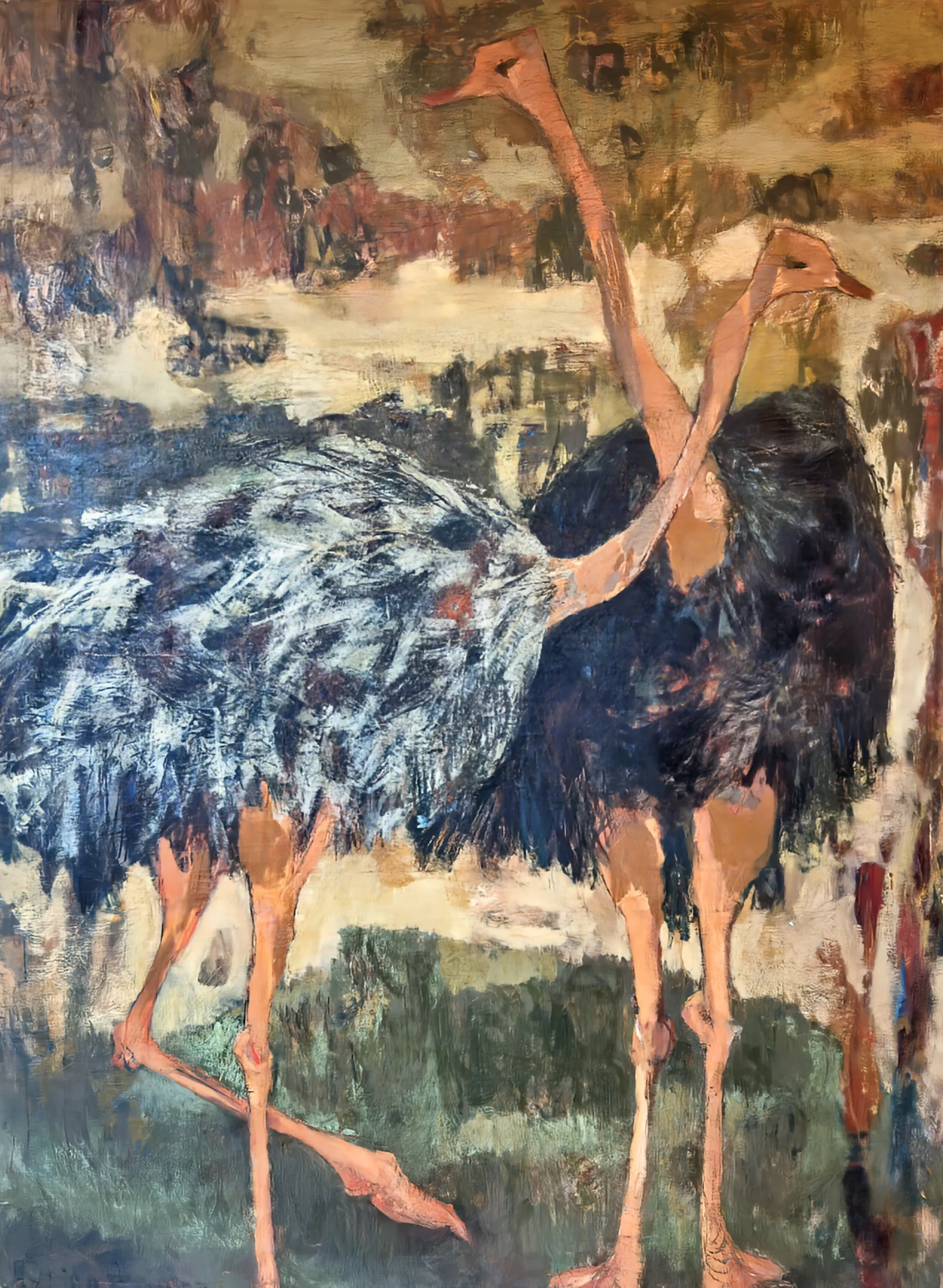
Ostriches (타조들)
1959; Oil on canvas, 48 x 60 in; National Art Exhibition of Korea, 1959; artist’s own collection
Her early works reveal an artist attempting to balance tradition and modernity. Ostriches is one of Yoo’s few semi‑abstract compositions. Painted as a sophomore in college, broad semi‑abstract forms and softened brushwork show disciplined composition and emotional subtlety. The palette of muted browns and creams accented with faint turquoise evokes both vitality and melancholy. Created under the mentorship of Kim In‑Seung, the painting reveals a young artist testing the boundaries between realism and expression.
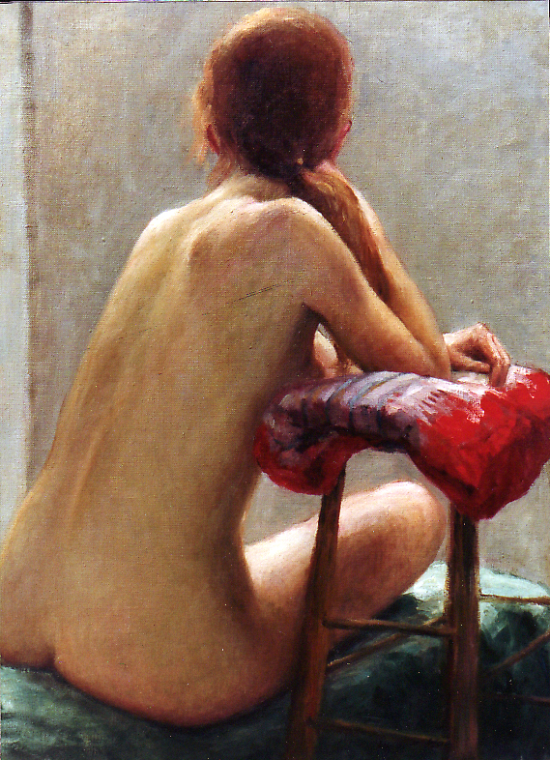
Sitting Model (앉아 있는 모델)
Early 1970s; Oil on canvas, 24 x 36 in; National Academy of Design, New York; private collection
Created while studying under Robert Philipp, Sitting Model depicts a figure seen from behind, rendered in subtle chiaroscuro. The absence of facial features shifts the focus from personal identity to posture and presence. The muted palette and soft transitions of light recall classical figure studies yet evoke modern sensibility. Paradoxically, Yoo’s habit of arriving late to class, finding models already settled into position, led her to develop this distinctive rear-view perspective.
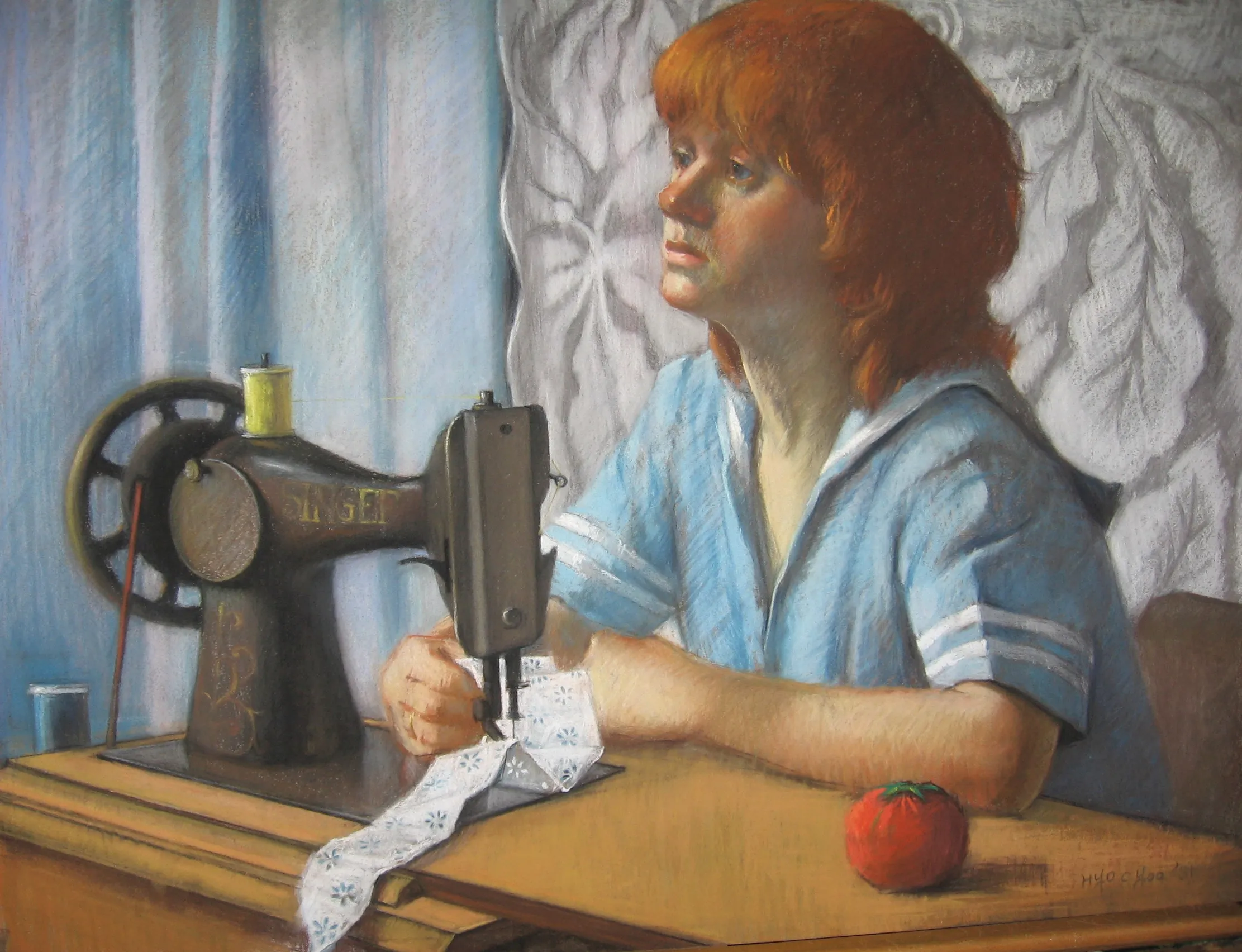
Girl at Sewing Machine (재봉틀 앞의 소녀)
Girl at Sewing Machine (재봉틀 앞의 소녀)
Mid‑1970s; Oil pastel on paper, 24 x 18 in; Art Students League of New York; private collection
This work, painted during evening studies with Daniel Greene, portrays a seamstress in concentrated labor. The play of reflected light on the sewing machine and the warmth of the figure’s face demonstrate Yoo’s ability to merge technical accuracy with compassion. Greene praised her mastery of realism that ‘feels rather than measures.’ By infusing industrial work with quiet humanity, the painting foreshadows her later depictions of her mother at daily chores.
Other Works
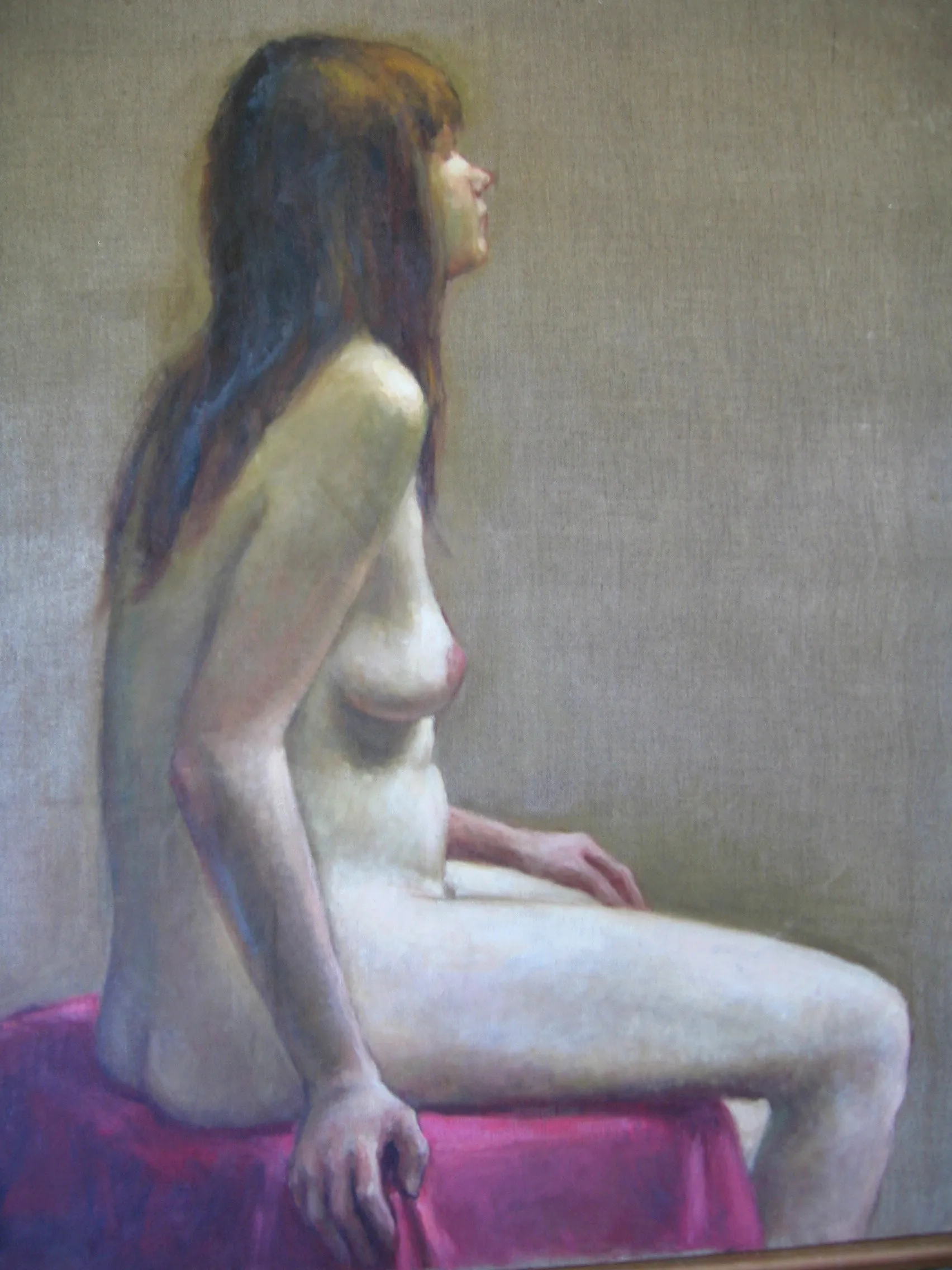
Seated Body (앉은 몸)
1970s; Oil on canvas; 22 x 28 in
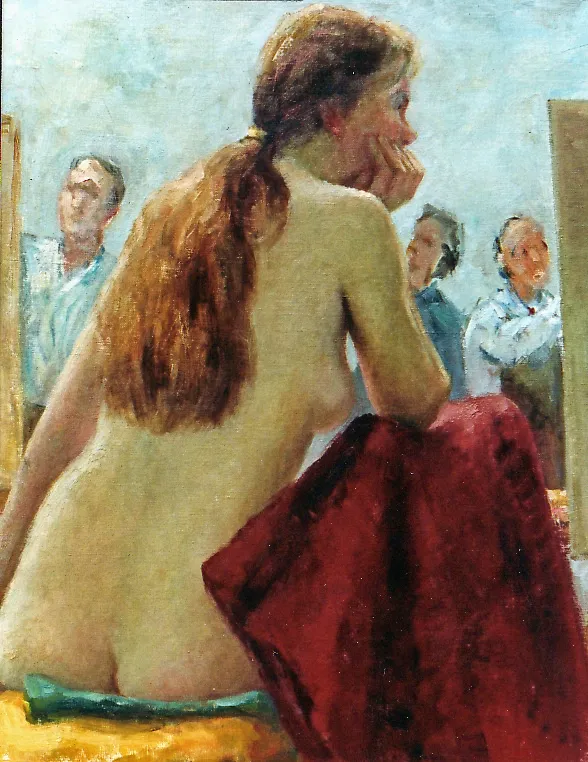
Reflective Figure (비춘 몸)
1970s; Oil on canvas; 24 x 36 in
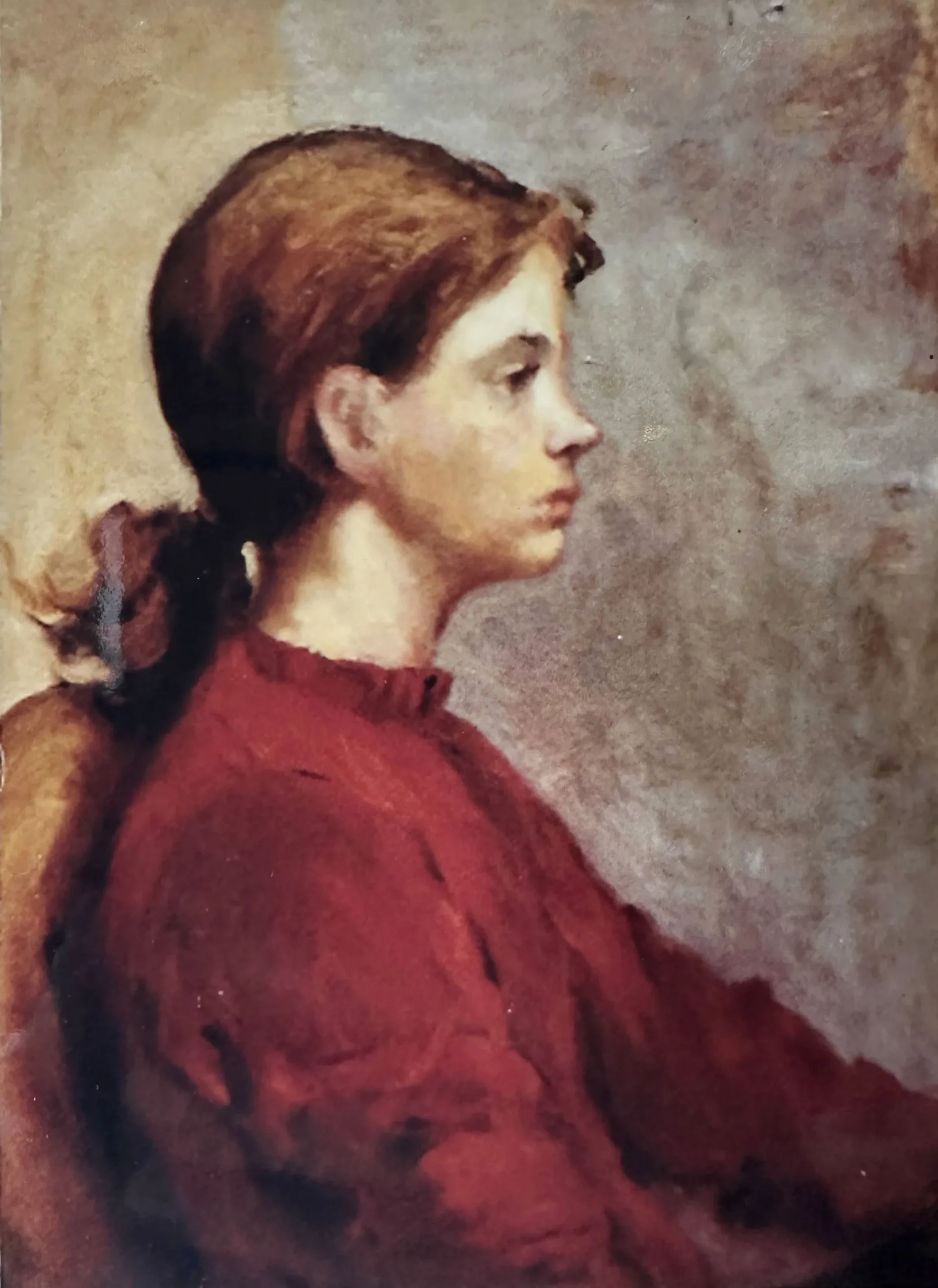
Profile in Red / 붉은 옆모습
1970s; Oil on canvas; 14 x 20 in
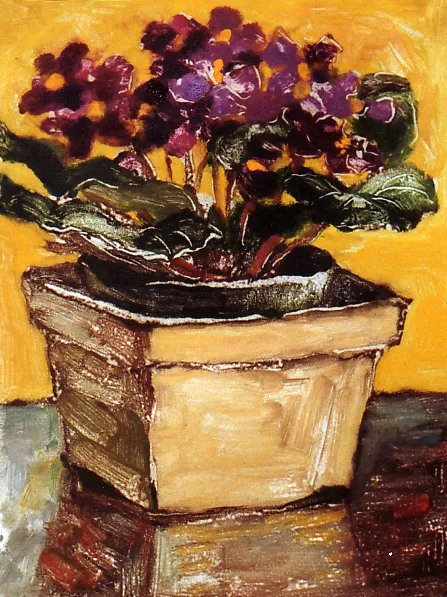
Potted Bloom / 화분의 꽃
1970s; Monotype; Oil on canvas; 24 x 36 in
Western Realism & 1987 Return Exhibition
By the 1980s, Yoo had matured into a transnational realist whose work bridged Eastern restraint and Western painterly techniques. Her first U.S. solo exhibition at Upsala College in 1984 introduced her still lifes and portraits to American audiences. Three years later, her return exhibition at Seoul’s Josun Hotel (1987) marked a triumphant homecoming. Her works were praised by critics for its compositional and technical rigor and emotional warmth.
Lee Kyung‑Sung, Director of the National Museum of Contemporary Art, praised her in his exhibition foreword:
“She neither succumbed to abstraction nor followed transient waves. Her still lifes possess not cold accuracy but warm depth — a Korean lyricism beneath discipline.
In Yoo Hyo Chong’s still lifes one perceives a harmony of accurate observation and refined taste. She has steadfastly walked her own path — a solitary road devoted to the world of reality.”
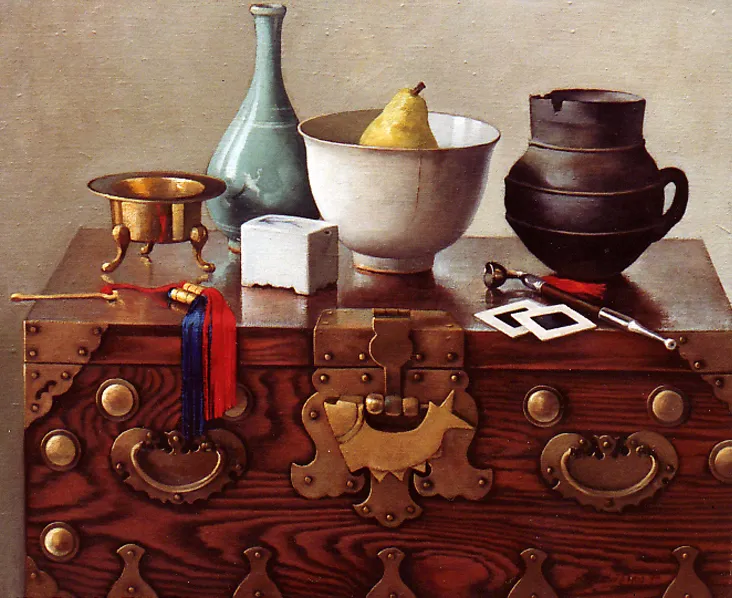
Chest Still Life (장 속 정물)
Chest Still Life (장 속 정물)
1980s; Oil on canvas, 24 x 18 in, Josun Hotel Gallery Exhibition, Seoul, 1987; private collection
Painted during her teaching years at Upsala College, this still life shows Yoo’s dedication to realism that is infused with life rather than mechanical. A pear, ceramic vessels, brassware, carved wood, and metal fittings each carry their own distinct presence. Yoo’s meticulous handling of texture, glazed porcelain, cool celadon, warm brass, rough-hewn wood, beckons the eye to sense their weight and temperature. Though the objects are manmade, she treats them as if they possess quiet inner lives.
Still Life with Guitar (기타가 있는 정물)
1980s; Oil on canvas, 18 x 24 in; Upsala College Gallery, 1984 Exhibition; private collection
Mechanical and organic elements intertwine in this carefully structured still life. The guitar, polished yet silent, anchors the composition against the softness of surrounding foliage. Yoo uses the golden ratio to balance geometry and emotion. Balanced carefully in composition and color, they form a small community of forms, each different yet in harmony. The result is a meditation on sound, form, and harmony, a dialogue between human craft and nature’s liveliness.
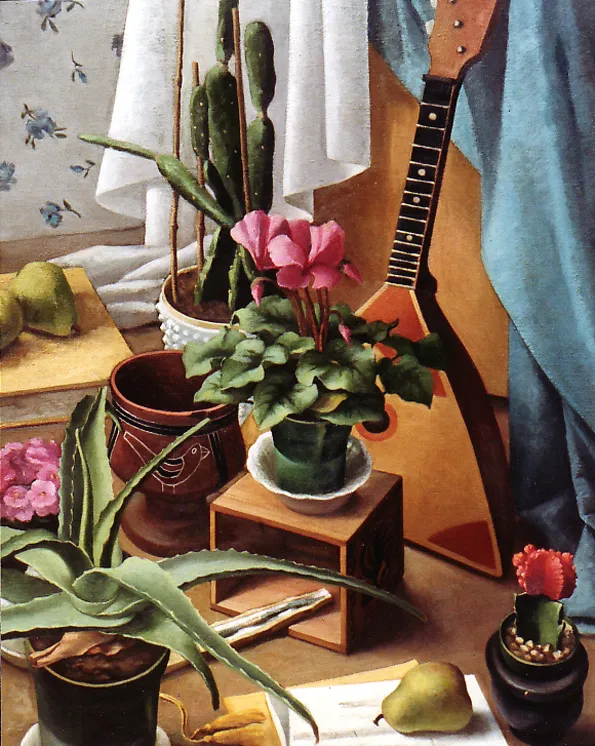
Still Life with Guitar (기타가 있는 정물)
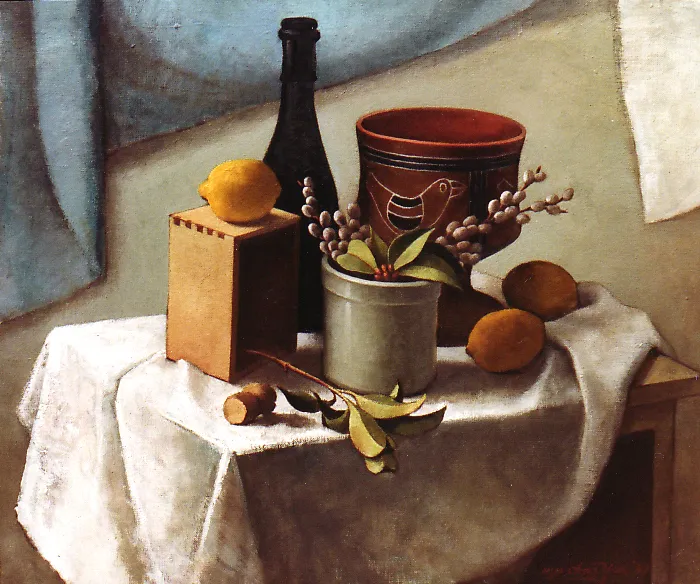
Still Life with Bird Vase (새 무늬 항아리 정물)
Still Life with Bird Vase (새 무늬 항아리 정물)
1980s; Oil on canvas; 18 x 16 in; Josun Hotel Gallery Exhibition, Seoul, 1987; private collection
A primitive bird motif animates this serene still life. Arranged objects of varying height and texture achieve compositional balance, while the angled tabletop introduces subtle tension. The bird symbolizes breath and renewal within stillness, echoing the artist’s duality, discipline and sensitivity, that critic Lee Kyung‑Sung has discerned as the essence of her realism. Yoo animates the everyday objects, giving them dignified presence.
Yellow Chrysanthemums (노란 국화)
1980s; Oil on canvas; 22 x 36 in; Josun Hotel Gallery Exhibition, Seoul, 1987; private collection
Every petal in Yellow Chrysanthemums seems to radiate inward light. Yoo contrasts bright yellows and oranges with a dark, purplish background, creating optical vibration and emotional depth. The red scissors on the table set amidst fallen leaves and yellow petals form a symbolic link between vitality and mortality — a reminder that even beauty is bound to impermanence.
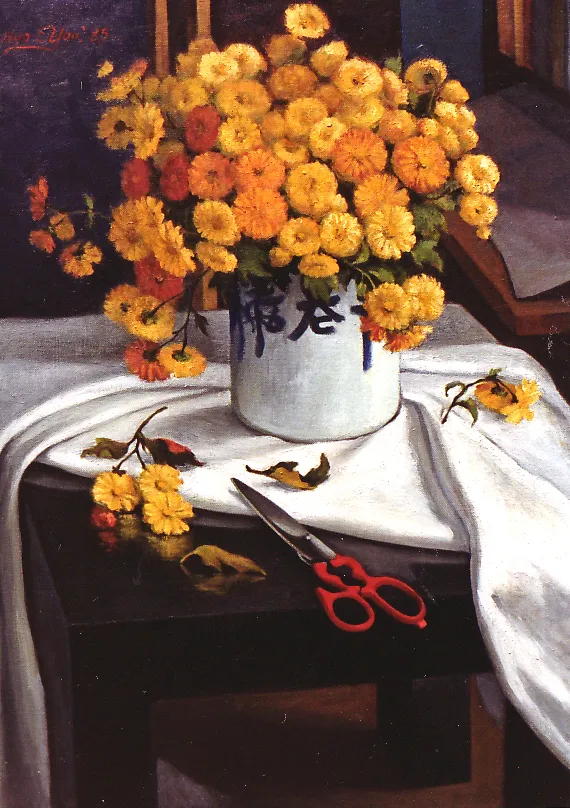
Yellow Chrysanthemums (노란 국화)
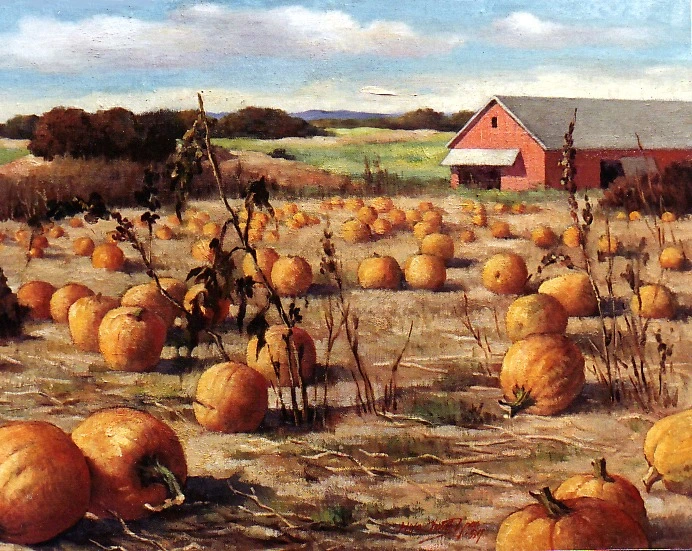
Pumpkin Field (호박밭)
Pumpkin Field (호박밭)
1980s; Oil on canvas; 28 x 24 in; Josun Hotel Gallery Exhibition, Seoul, 1987; private collection
Yoo transforms an ordinary autumn field into a meditation on seasonality and labor. The scattered pumpkins, rendered in warm ochres, contrast with the dry soil and brittle stalks that signal the end of growth. The red barn in the distance introduces a quiet human presence, grounding the scene in rural routine. The landscape is suspended between abundance and decline, an example of Yoo’s ability to capture quiet poetry in the everyday.
Willow Pond (버드나무 연못)
1980s; Oil on canvas, 28 x 24 in; Josun Hotel Gallery Exhibition, Seoul, 1987; private collection
In Willow Pond, Yoo portrays an atmosphere of calm through the mirrored symmetry of trees and sky reflected on still water. The modest white house and red outbuilding sit softly in the background, evoking distant memories. Subtle tonal shifts unify land and reflection, creating a serene and contemplative mood. The painting captures Yoo’s signature artistic approach: realism imbued with emotional depth, where light and colors transform a simple landscape into a moment of introspection.
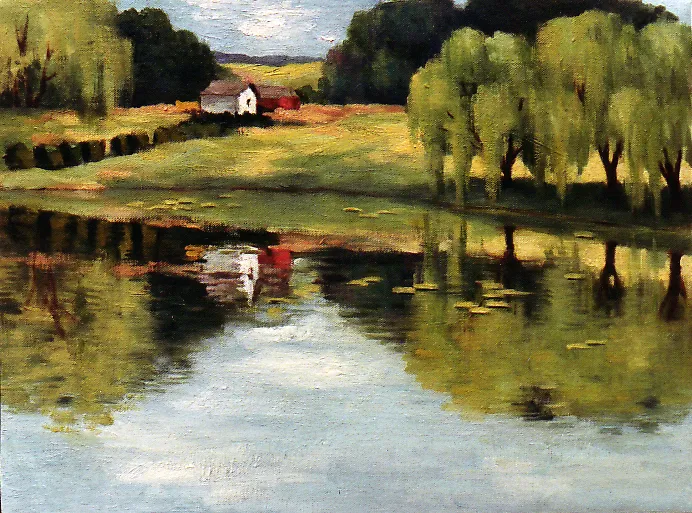
Willow Pond (버드나무 연못)
Other Works
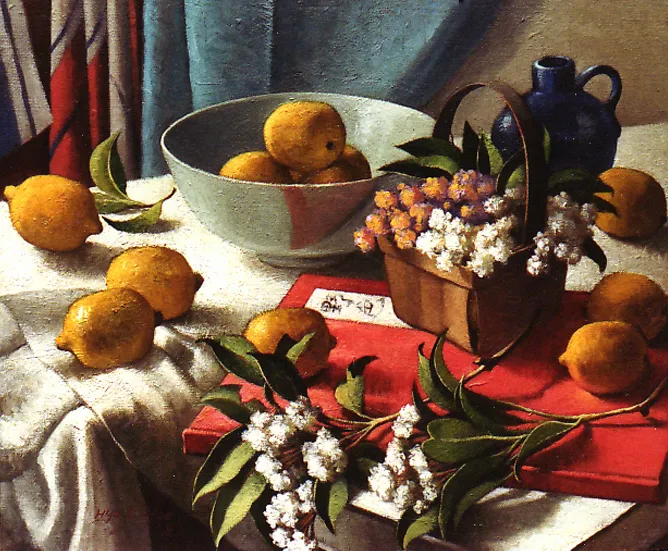
Lemons and White Cloth 레몬과 흰 천
1980s; Oil on canvas, 24 x 18 in
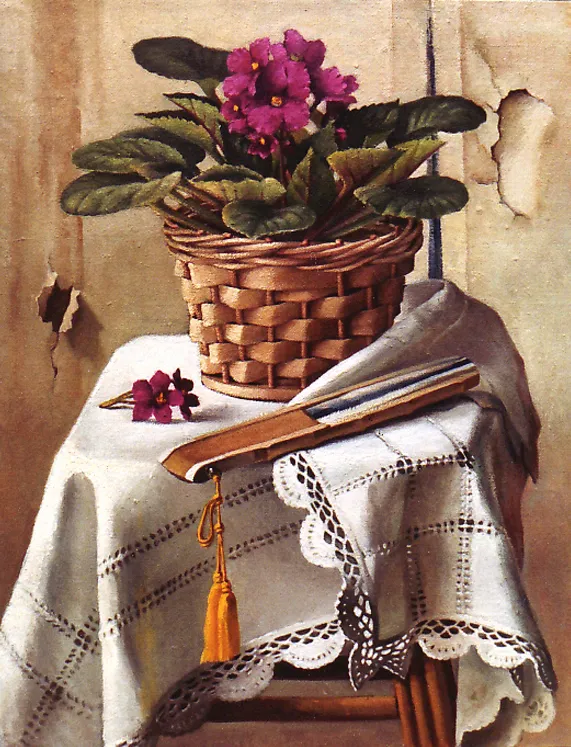
Violet in a Woven Basket 바구니 속 제비꽃
1980s; Oil on canvas, 18 x 24 in
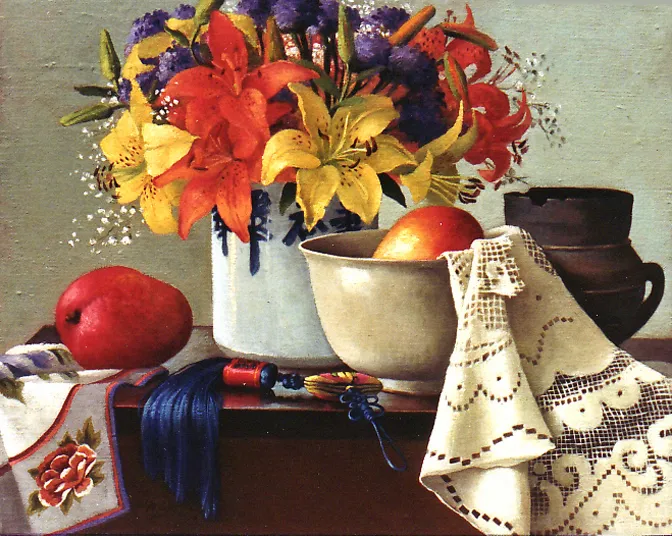
Lilies and Bowl 백합과 그릇
1980s; Oil on canvas, 24 x 18 in
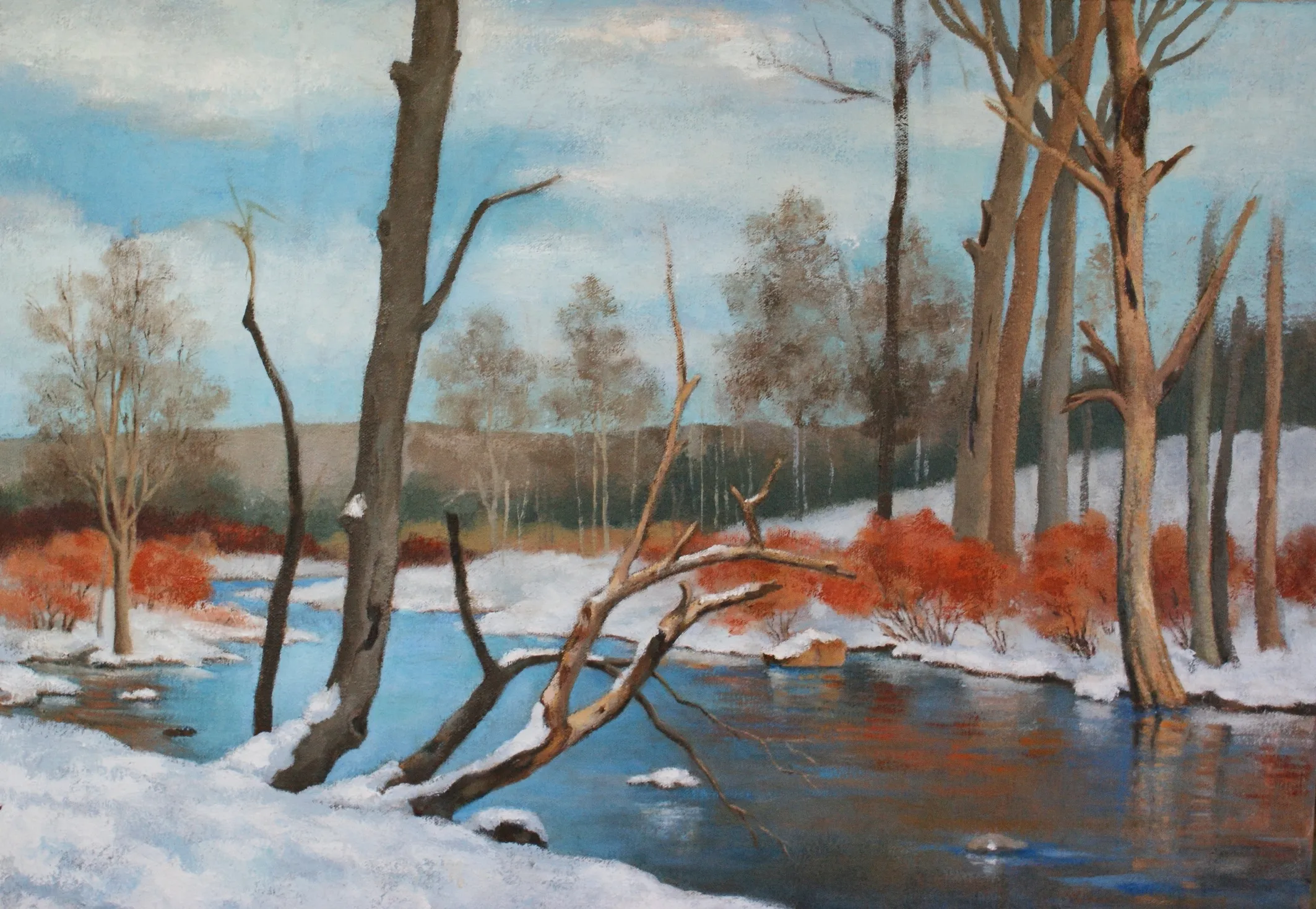
Winter Trees 겨울 나무
1980s; Oil on canvas, 24 x 18 in
Portraits of Her Mother — The Muse
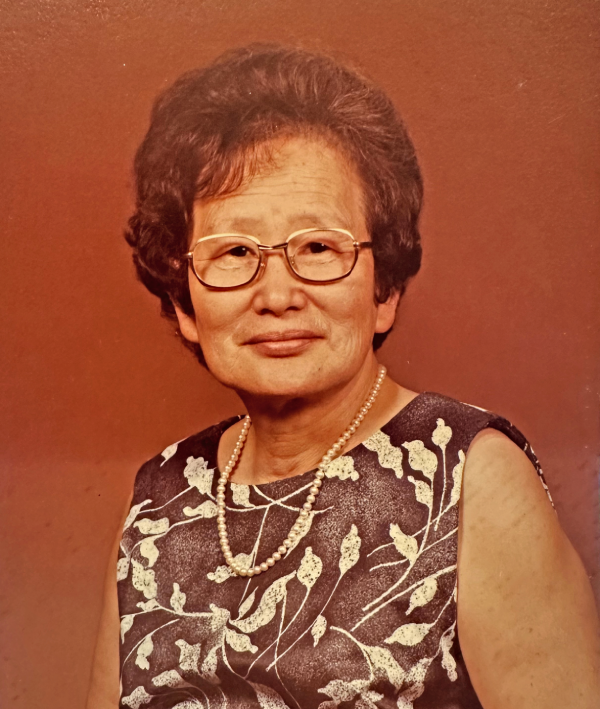
Through the 1980s and 1990s, Yoo’s mother, Kim Kwan‑Sum, became both model and muse. Her mother’s patience and humor reveal themselves: “Fine, go ahead and draw as much as you like… it’ll only end up being an ugly old woman anyway.”
Yoo states “Yet she stayed. Each sitting revealed her strength and patience. . . I came to see that painting her was like painting my own heart. Each line in her face held memory—grief, labor, tenderness. I wanted others to see the beauty in her perseverance, the quiet dignity of a mother’s life lived entirely for others. Through her I learned that love is silent, constant, and eternal. My art became a way to say thank you.”
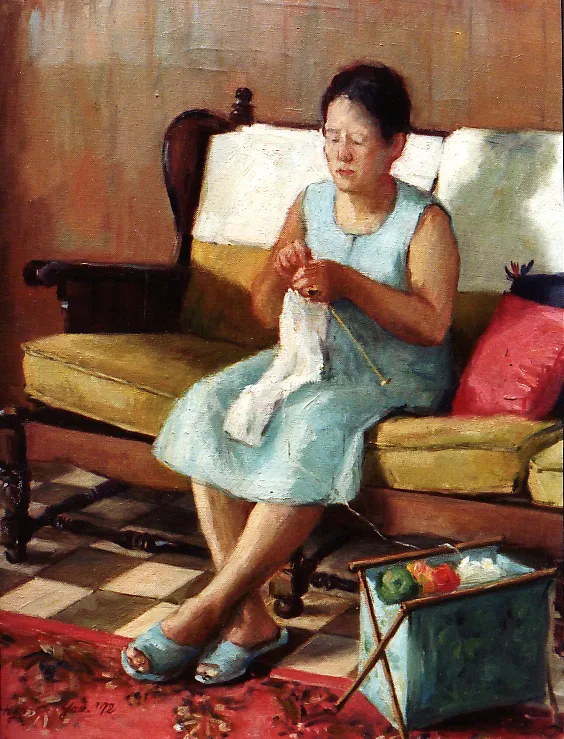
Mother Knitting (뜨개질하는 어머니)
1980s; Oil on canvas, 18 x 24 in; Artist’s Collection
This painting transforms a humble domestic task into a scene of understated significance. The interlacing lines of yarn mirror the structure of the composition, while the golden couch and tiled floor create rhythmic tension. Blue and red tones course through the canvas, imbuing vitality. Yoo portrays labor not as toil but as an expression of love, something beautiful and useful shaped through patience.
Morning Coffee (아침 커피)
1990s, Oil on canvas, 36 x 22 in; Artist’s Collection
After the family has departed, morning light rests on her mother’s contemplative figure. The triangular arrangement of head, arm, and shoulder stabilizes the composition. Behind her, a white calendar punctuates the quiet, a record of time’s passage. The painting conveys solitude without sadness, where quiet pause becomes both dignified and quietly transformative.
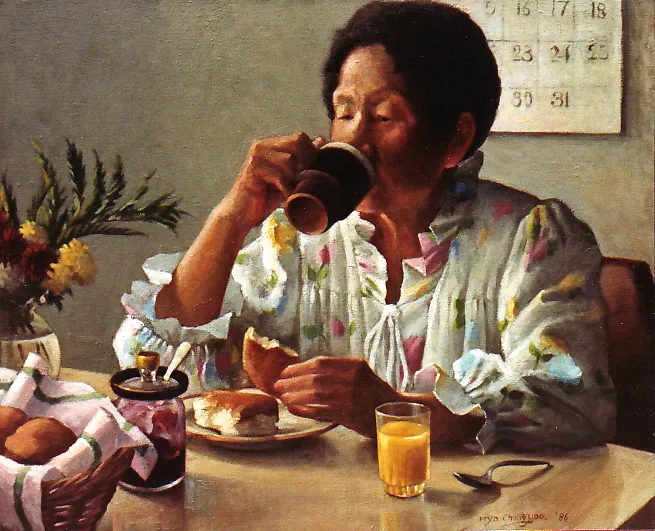
Morning Coffee (아침 커피)
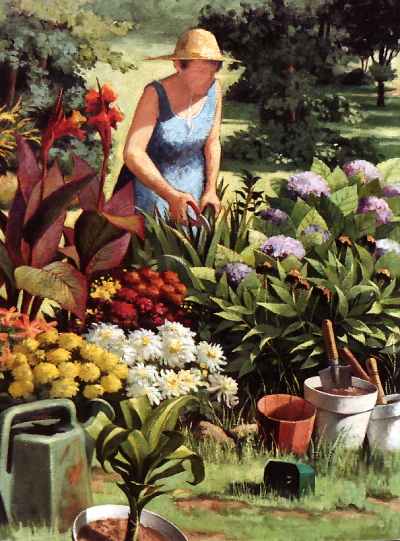
Mother Gardening (정원 가꾸는 어머니)
1980s, Oil on canvas, 24 x 36 in; Artist’s Collection
This painting shows Yoo’s mother caring for her garden on a warm, bright day. She leans gently over the plants, completely absorbed in the work of pulling weeds and tending the flowers. Sunlight catches her hat and shoulders, giving her a calm, steady presence within the lush landscape. Everyday tools like watering cans and buckets sit nearby, reminding us that this beauty comes from patient, repeated effort. Yoo presents his mother’s gardening as an act of quiet devotion. Through simple, daily care, she brings life and order to the space around her, and the flourishing plants reflect her steady, nurturing spirit.
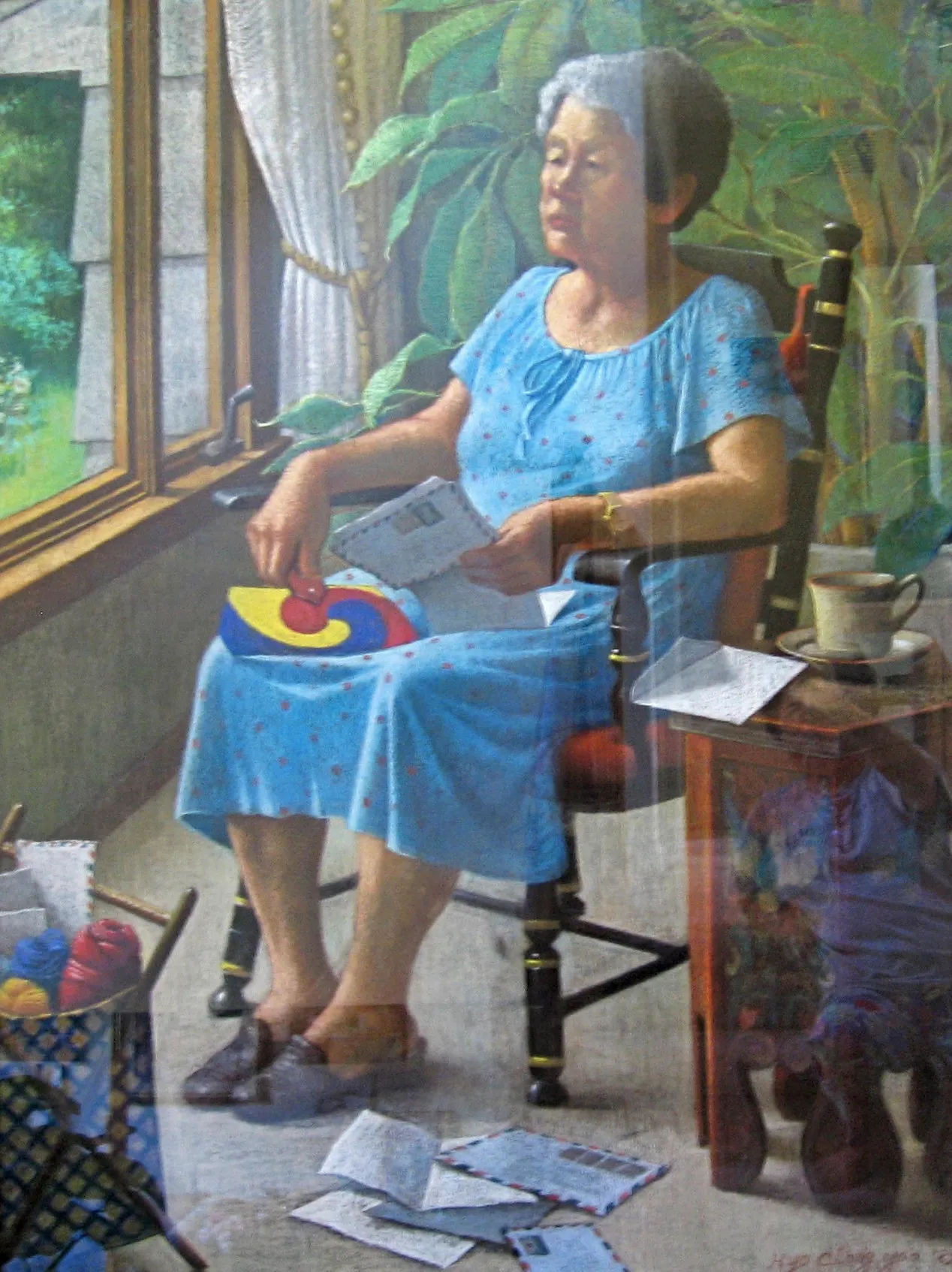
Letters (편지)
1990s, Oil pastel on canvas, 48 X 60 in; Artist’s Collection
This large oil-pastel work portrays Yoo’s mother gathering and rereading letters sent to and from Korea, a personal archive that holds the weight of affection, distance, and the quiet ache of immigrant life. Her expression carries a soft, persistent longing, and her body angles instinctively toward the window, as if attuned to a faraway horizon. The blue, red, and yellow of the Korean fan, echoed again in the yarn spools nestled in the knitting basket, and the presence of the low Korean side table subtly intensifies the theme of yearning for home, entwining memory and cultural inheritance into a single, evocative scene.
Other Works
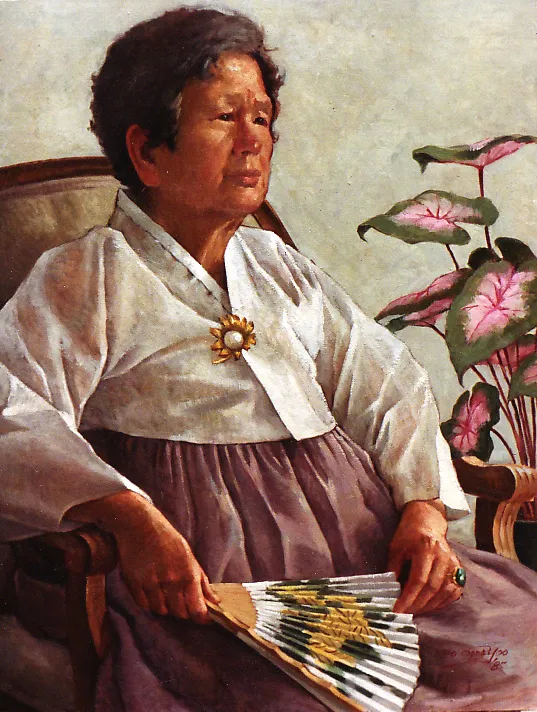
Mother with Fan (부채 든 어머니)
1990s, Oil on canvas, 36 X 48 in
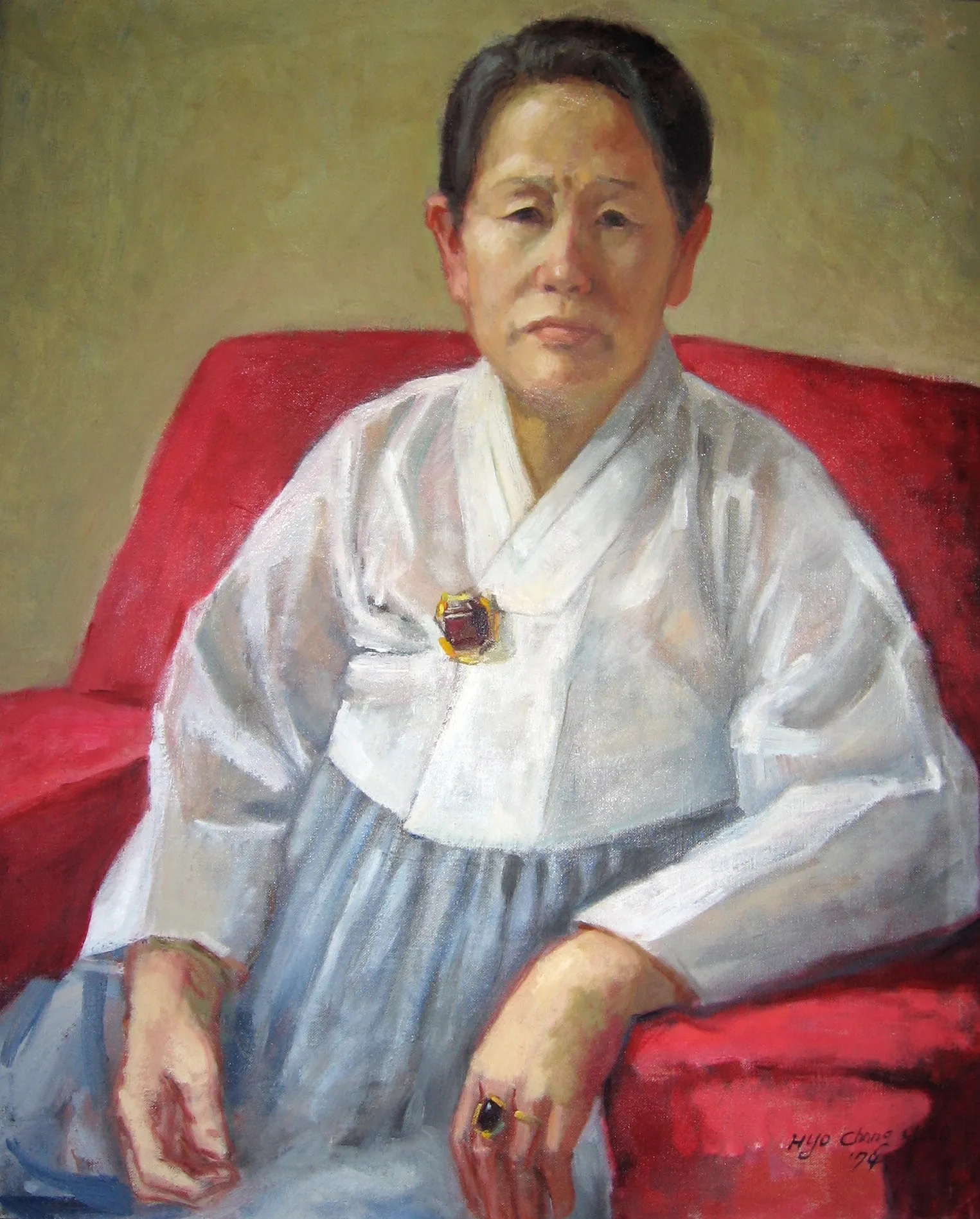
Seated Mother (앉은 어머니)
1980s, Oil on canvas, 24 X 36 in
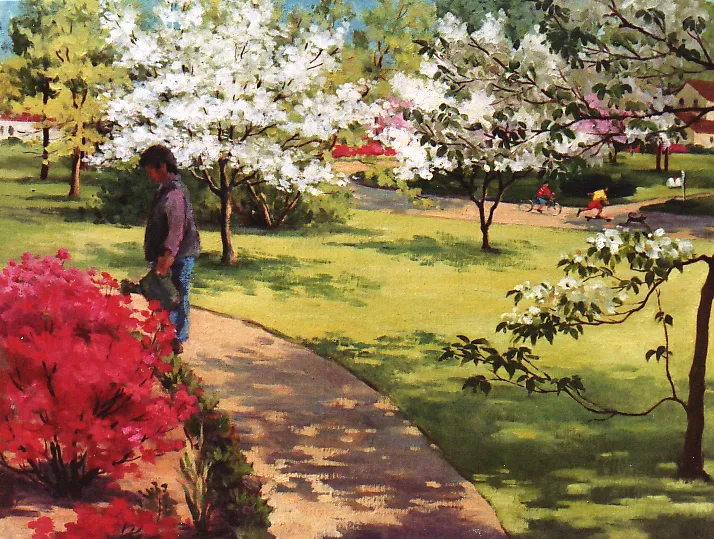
Passing Spring (지나가는 봄)
1980s, Oil on canvas, 36 X 24 in
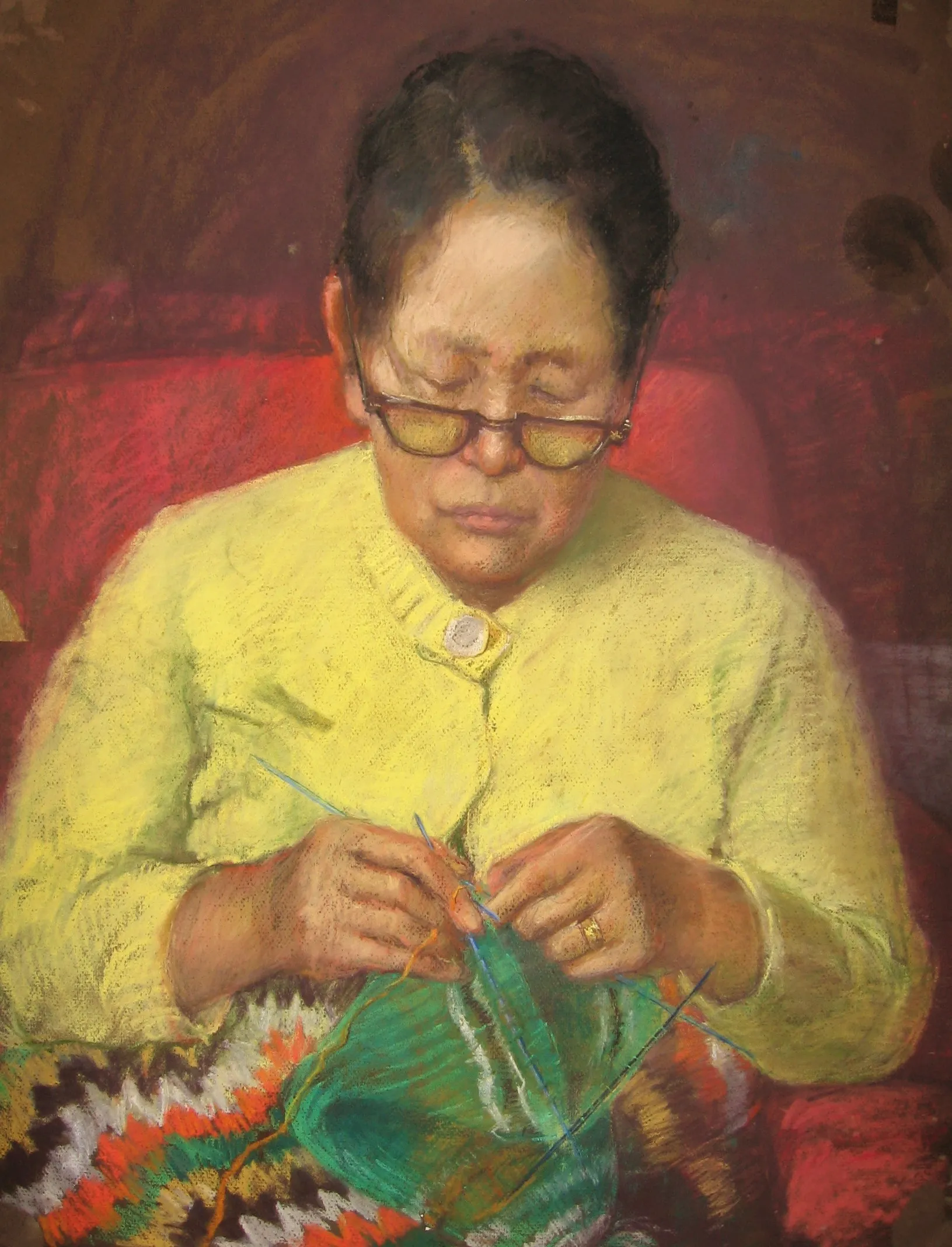
Mother Knitting (#2) (뜨개질하는 어머니 #2)
1980s, Oil pastel on paper, 18 X 24 in
Memories, Korean Motifs & Renewal
After years of profound grief and a long hiatus following the loss of her beloved younger sister in 1989 and her mother in 2004, Yoo found her way back to painting through memory and heritage. In these later works, Yoo returns to her Korean roots with renewed purpose, merging technical mastery with Korean motifs and a sense of spiritual renewal. Hanji paper, Goryo-era pottery, norigae (traditional Korean ornament), obangsaek (five cardinal colors of Korean tradition) palette and Korean shaman ritual dance appear as symbols of Yoo’s cultural heritage, and personal possessions that once belonged to her mother become central motifs. In these gestures, Yoo affirms both her mother’s memory and her cultural lineage, transforming acts of remembrance and reclamation into an enduring artistic practice.
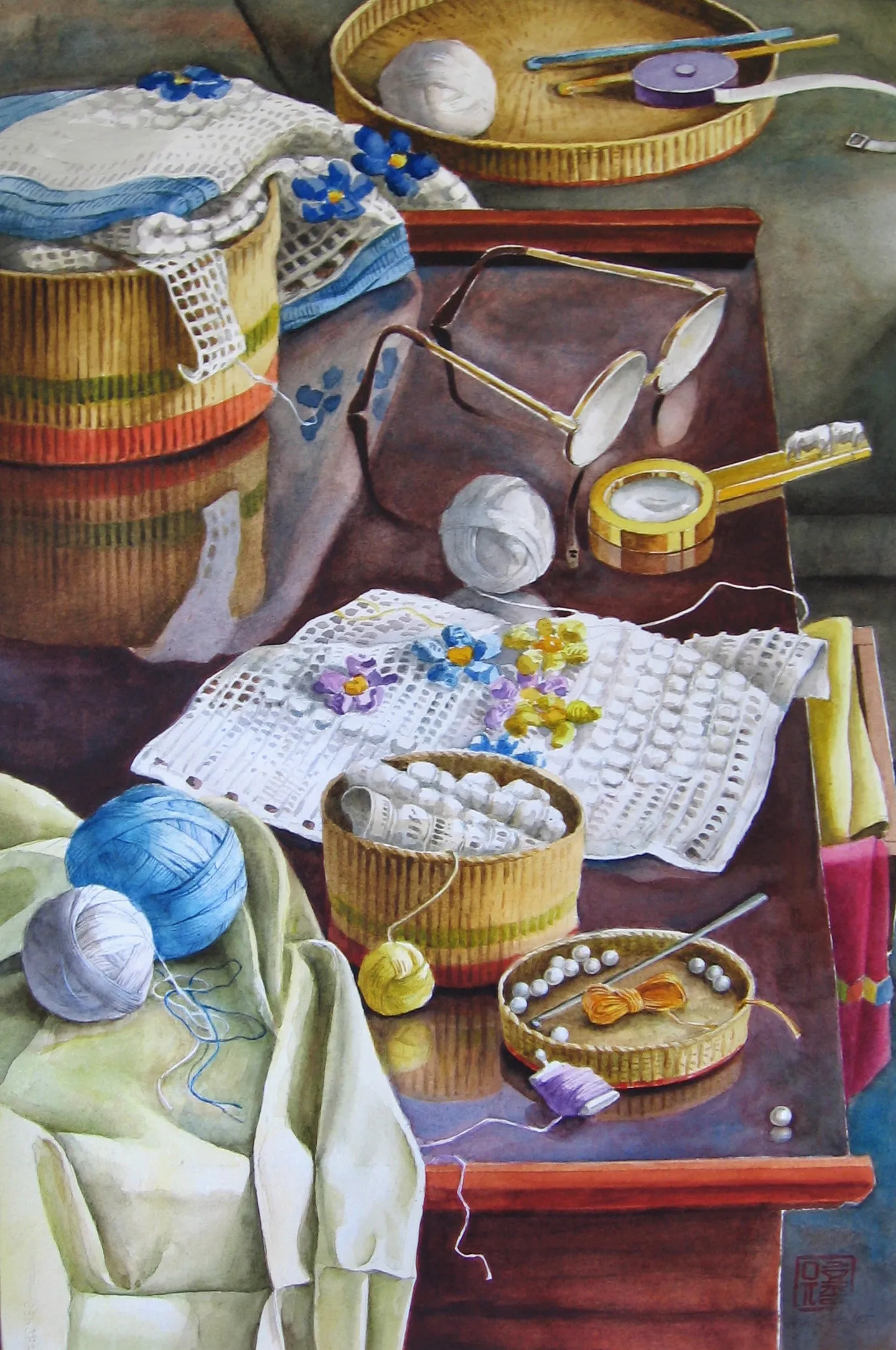
Crochet Table (어머니의 뜨개상)
2010s; Watercolor on paper, 36 x 24 in; Artist’s Collection
Yoo arranges her late mother’s yarns, needles, glasses, and the unfinished crochet blanket meant as a wedding gift for Yoo (who never married), turning a simple work table into a poignant memorial. Each object is rendered with crystalline precision, as if still carrying her mother’s touch. The polished surface that reflects the tools deepens the sense of presence and absence. Through luminous watercolor, ordinary materials become symbols of devotion, patience, and a love that continues beyond completion. This watercolor painting is one of 10 paintings that Yoo painted in memory and honor of her mother after her passing.
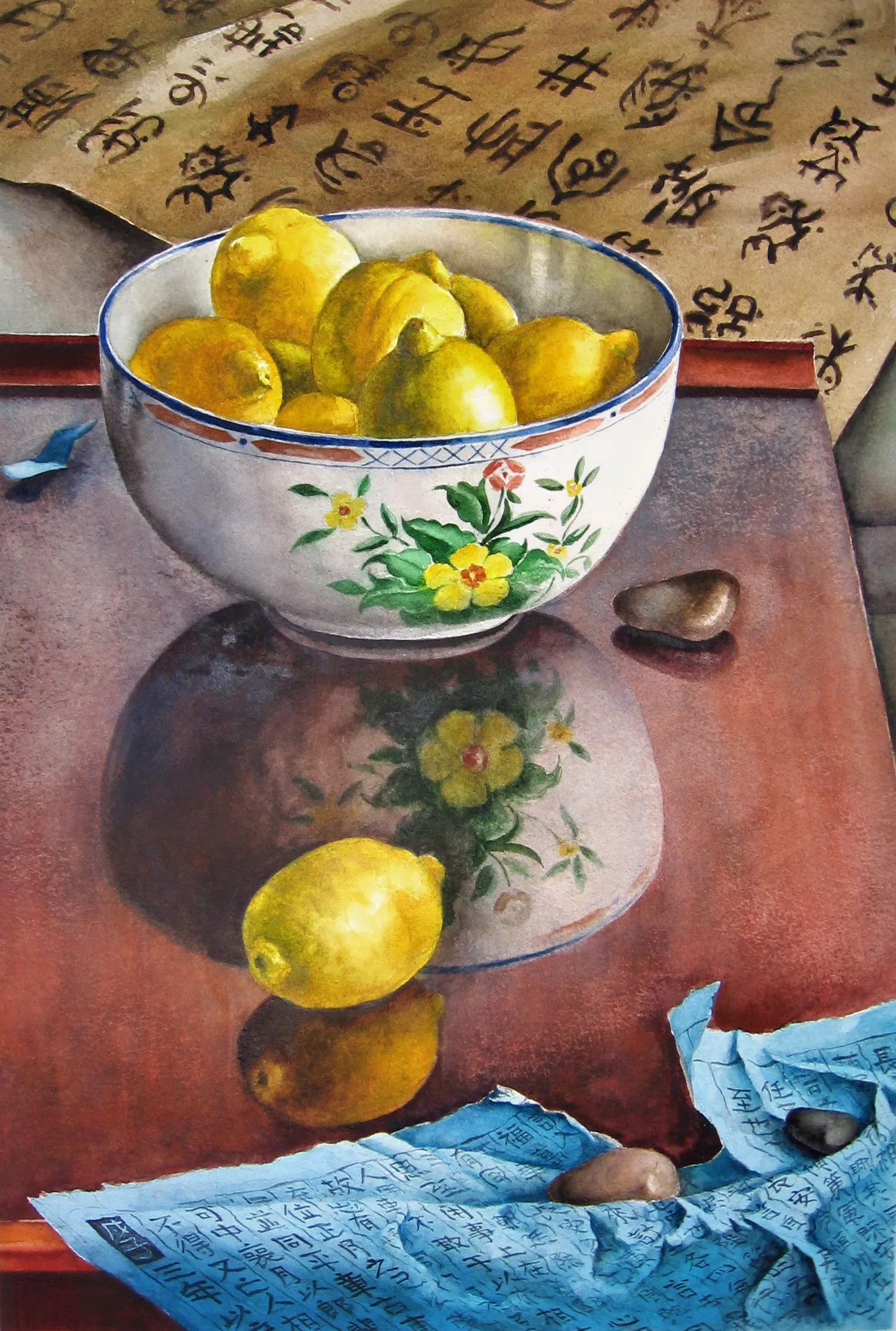
Korean Paper and Lemons (한지와 레몬 )
2010; Watercolor on paper, 36 x 24 in; Artist’s Collection
Yoo transforms a simple arrangement of lemons, hanji papers, and small stones into a quiet meditation on life. The bright bowl of lemon, reflected softly on the polished table, acts as a small sun at the center of the composition, its yellow suggesting vitality. Around it, the worn papers suggest the rhythm of language and heritage, while the stones steady the scene with their earthy presence. Through precise observation of texture and light, Yoo lets each object reveal its own life, creating a piece that feels at once intimate, rooted, and gently luminous.
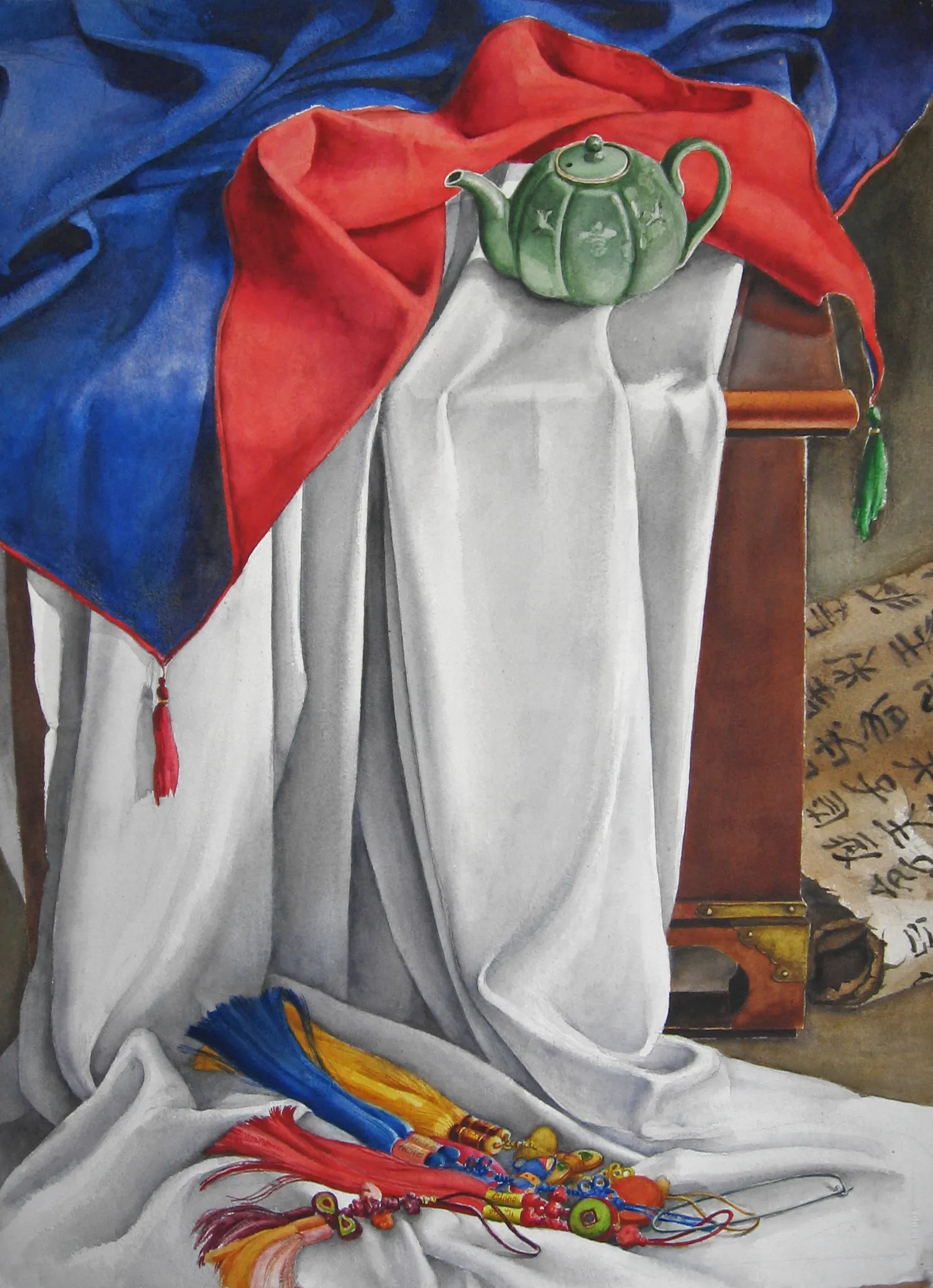
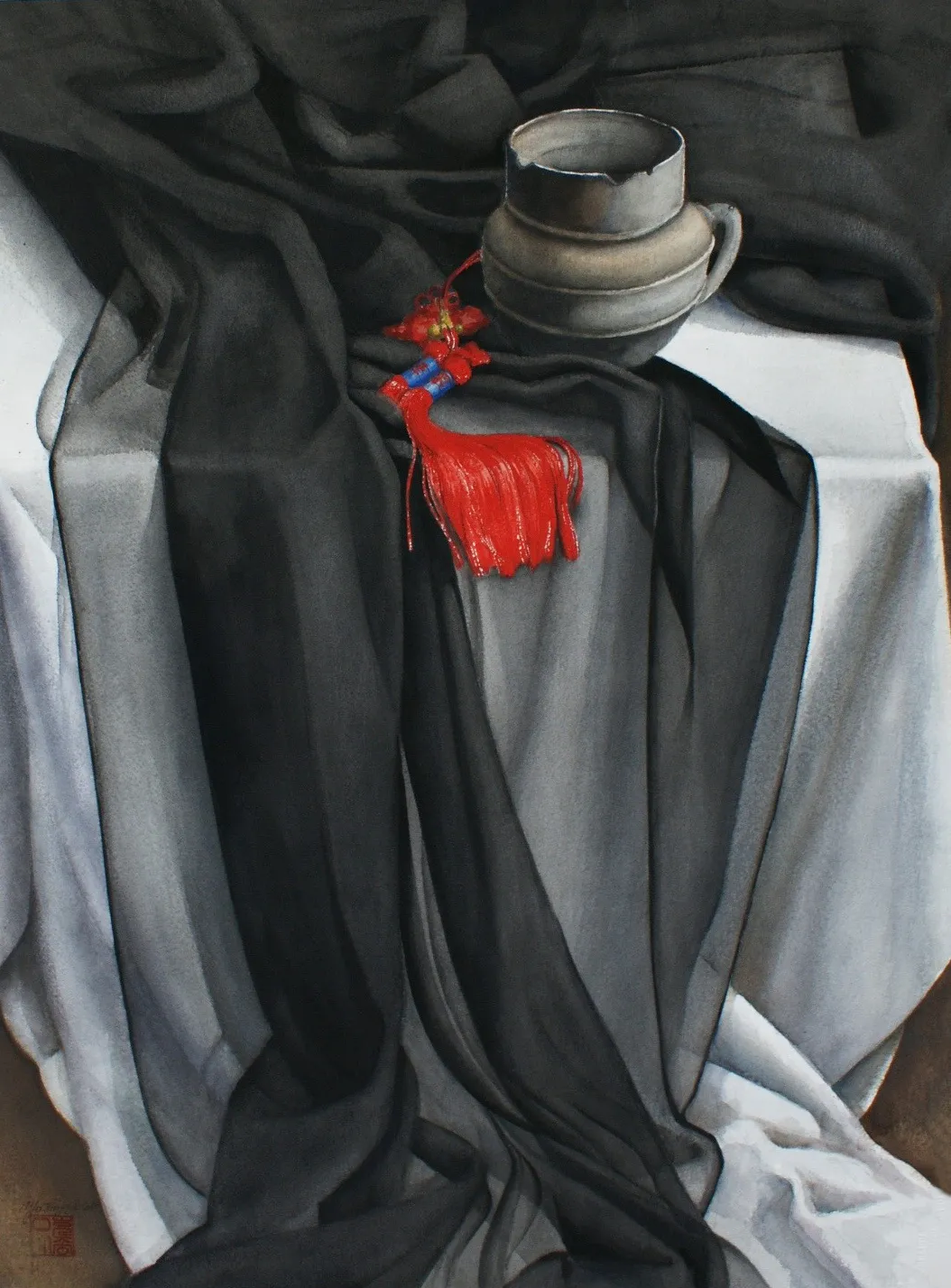
Red, Blue and White Drapery (No1)
and White and Black Drapery (No2) (드레이퍼리 No1 and No2)
2010s; Watercolor on paper, 48 x 60 in (each); Artist’s Collection
In this diptych, drapery becomes a living terrain, shaped by the pull of gravity into peaks, folds, and descents. In No.1, richly saturated cloths, blue, red, and white, spill in rhythmic layers, their edges catching light as they fall. A Korean celadon teapot anchors the drapery, its soft green glaze reflecting the elegance of a long ceramic tradition. The norigaes scattered across the lower drapery hint at Korean heritage and a sense of ceremony.
In No.2, the palette shifts to stark blacks and whites, and the fabric’s movement grows more austere. Here Yoo places an antique Goryeo-dynasty vessel, chipped but dignified, its weathered surface carrying the weight of centuries. A single red tassel provides a small but forceful flare of color, a reminder that even in stripped-down tones, memory persists.
Seen together, the two panels in the colors of obangsaek form a dialogue between freedom and restraint, celebration and contemplation. Yoo’s sustained inquiry into the way fabric falls, shaped by its own weight and gravity, creates a visual language of delicate balance between history and now, brightness and shade, and endurance and fragility.
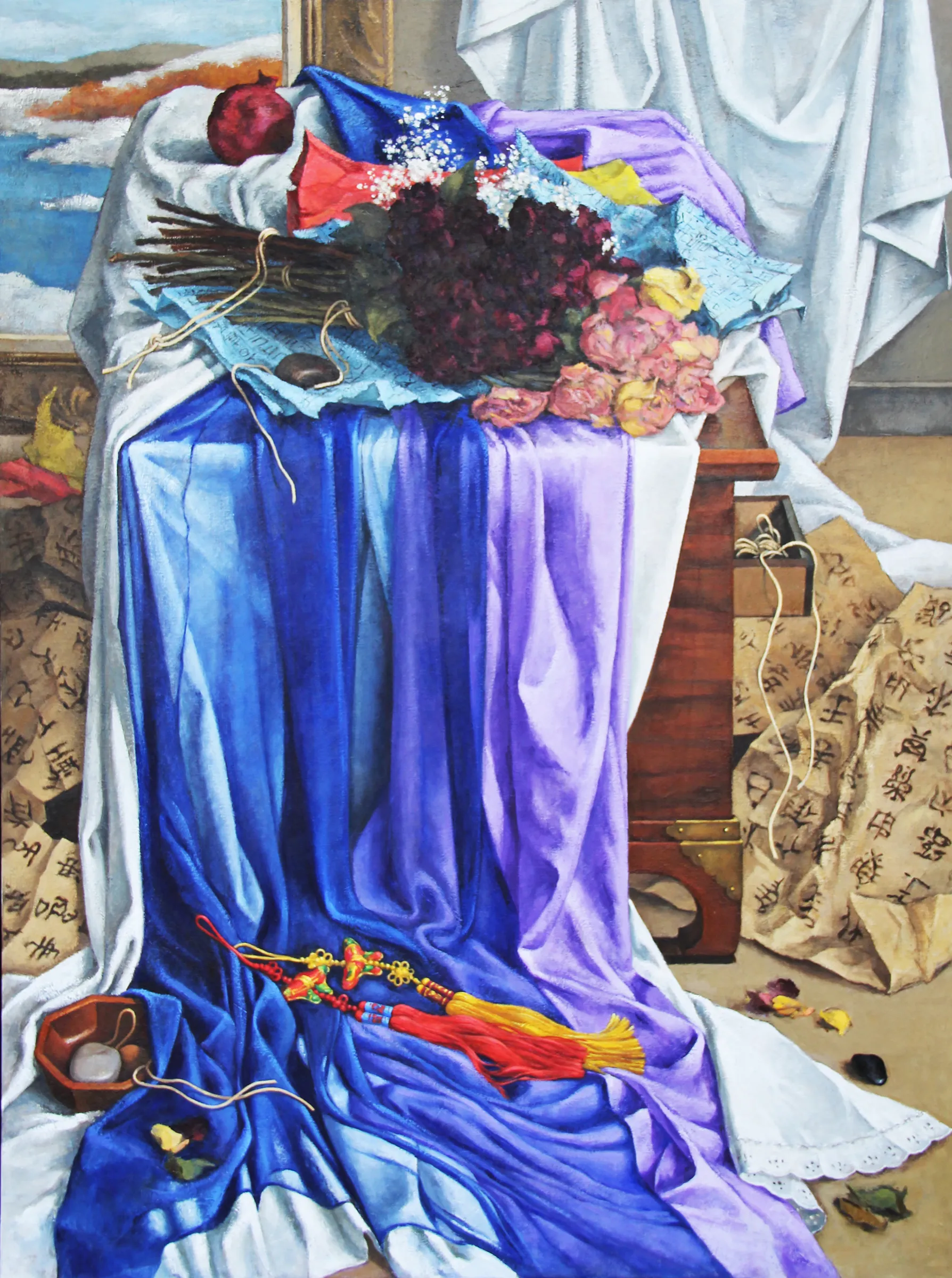
Affinity or Jeong (인연 or 정 )
2011; Oil on canvas, 48 x 60 in; Grand Palais Comparaison Exhibition, Paris, 2011
Yoo painted Affinity for an exhibition in Paris after she was selected as a part of the delegation representing Korea. The painting unites bright tones and lyrical symbolism. Paper and cloth, two materials that ‘can never meet but belong together’ (in Yoo’s words) embody separation and connection in life and love. Dried rose bouquet and smooth stones represent endurance, memory and longing. Again, Yoo pays homage to her heritage with Korean motifs, such as hanji paper and Korean chest. The composition opens to a background painting of the ocean horizon, expanding private memory into universal emotion.
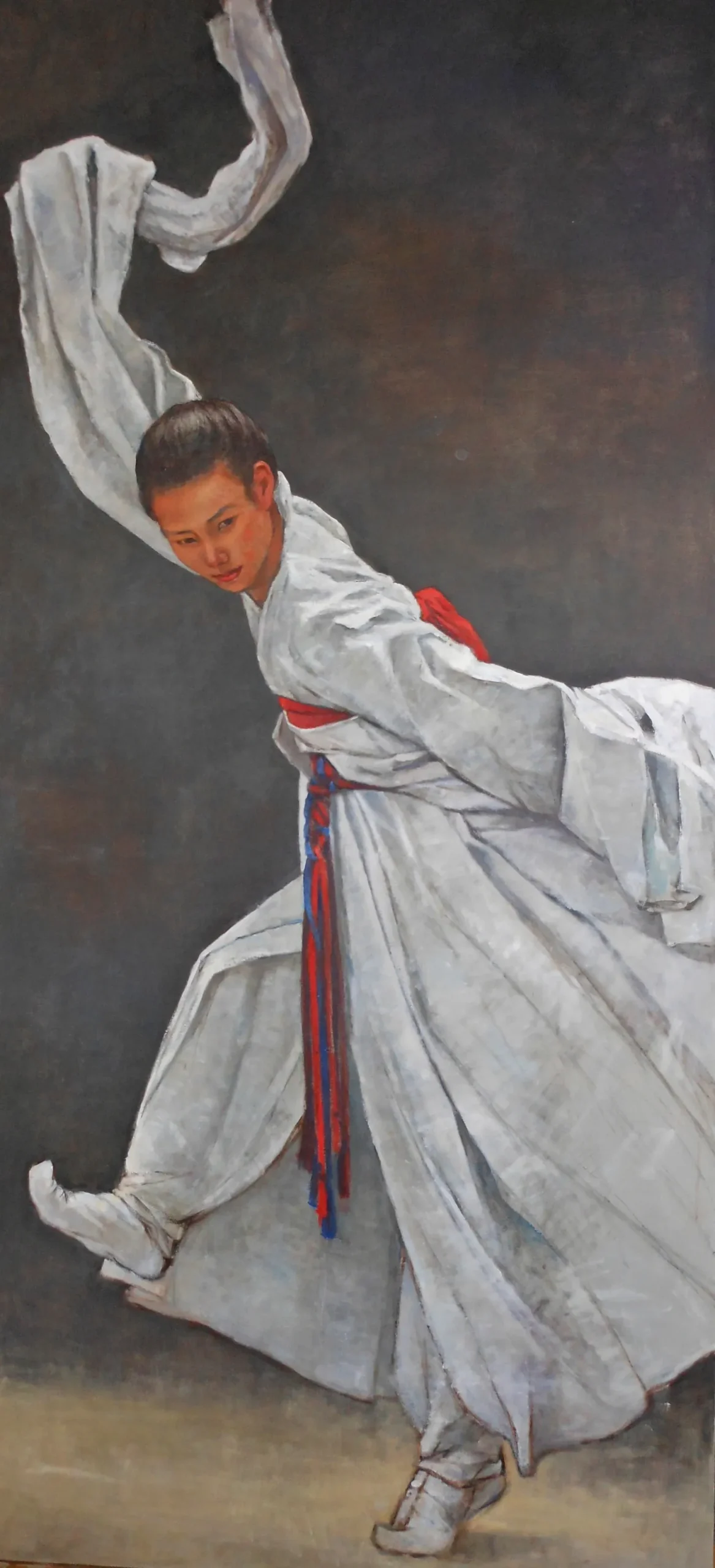
Salpuri or Beyond Han (한을 넘어서)
2017; Oil on canvas, 36 x 84 in; Collection of Centenary College
A powerful culmination of Yoo’s art, Sal‑puri channels ritual dance into visual catharsis. Sweeping brushwork captures movement dissolving grief and angst. Paint becomes spirit: layers of white, black, and red accents swirl into climactic motion of transcendence. Inspired by a dancer who overcame social inequity, the painting becomes an image of grace, forgiveness and liberation.
Other Works
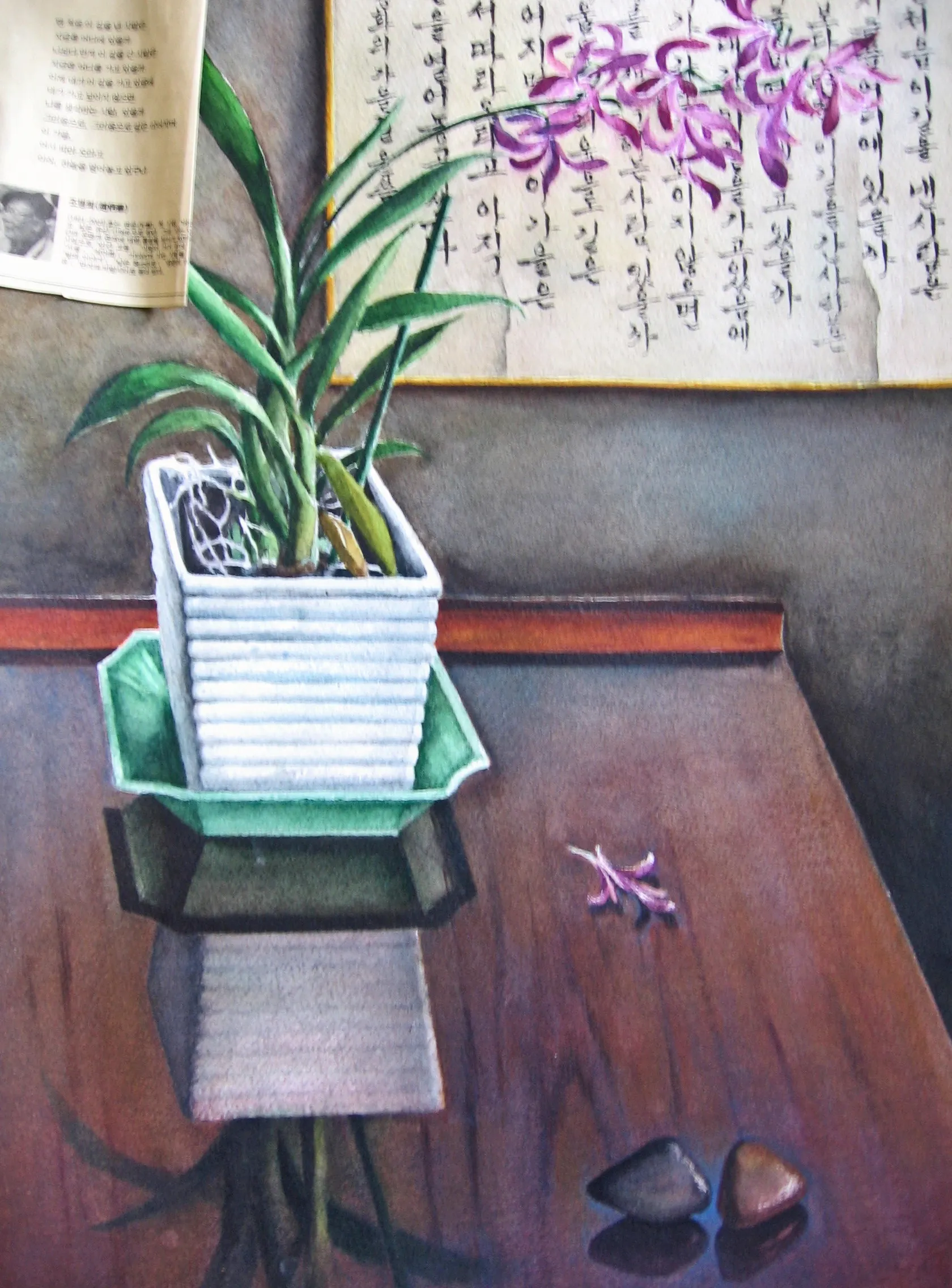
A Petal Remembered (기억된 꽃잎)
2010s; Watercolor on paper, 18 x 22 in
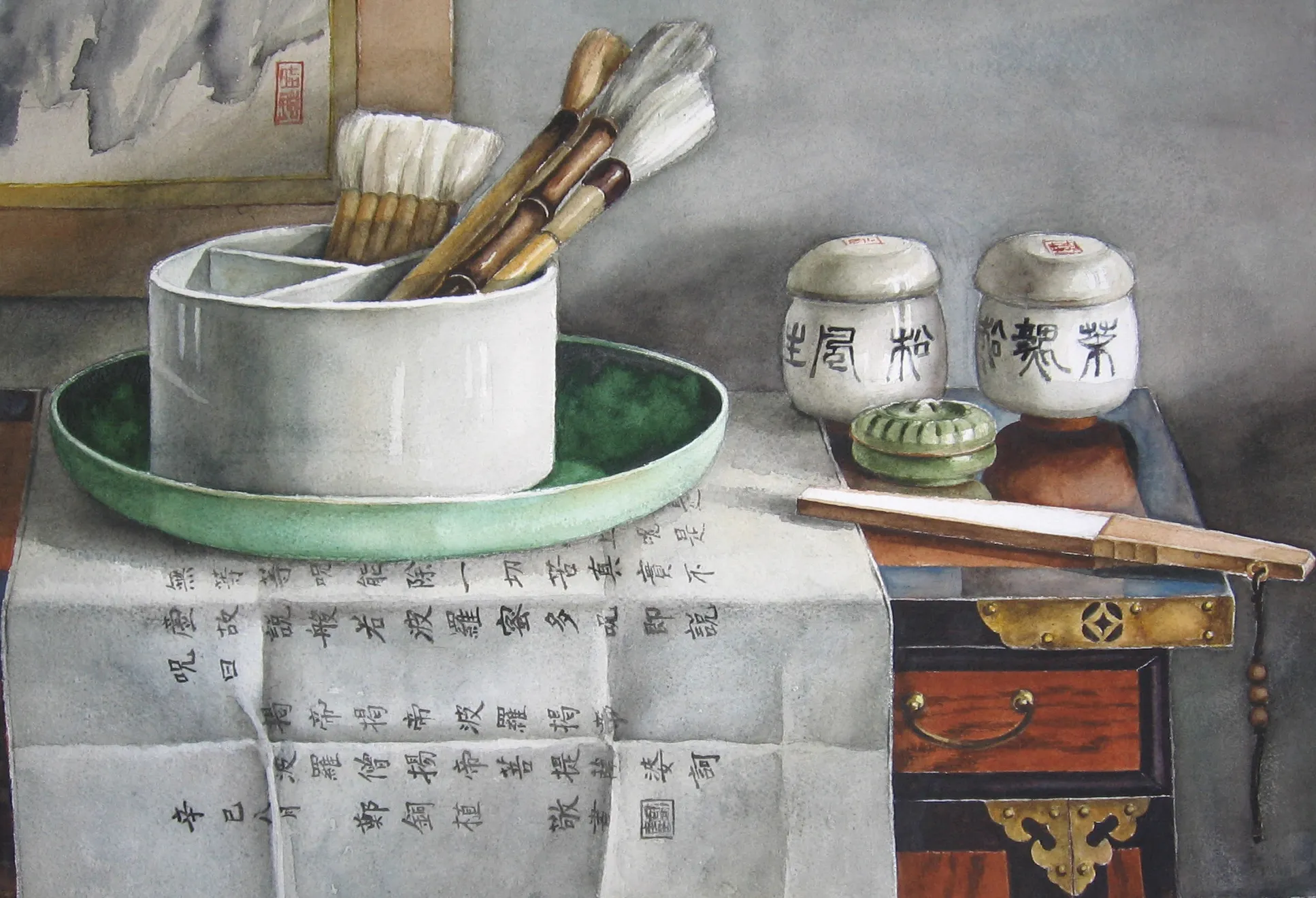
The Weight of Practice (수련의 무게)
2010s; Watercolor on paper, 36 x 24 in
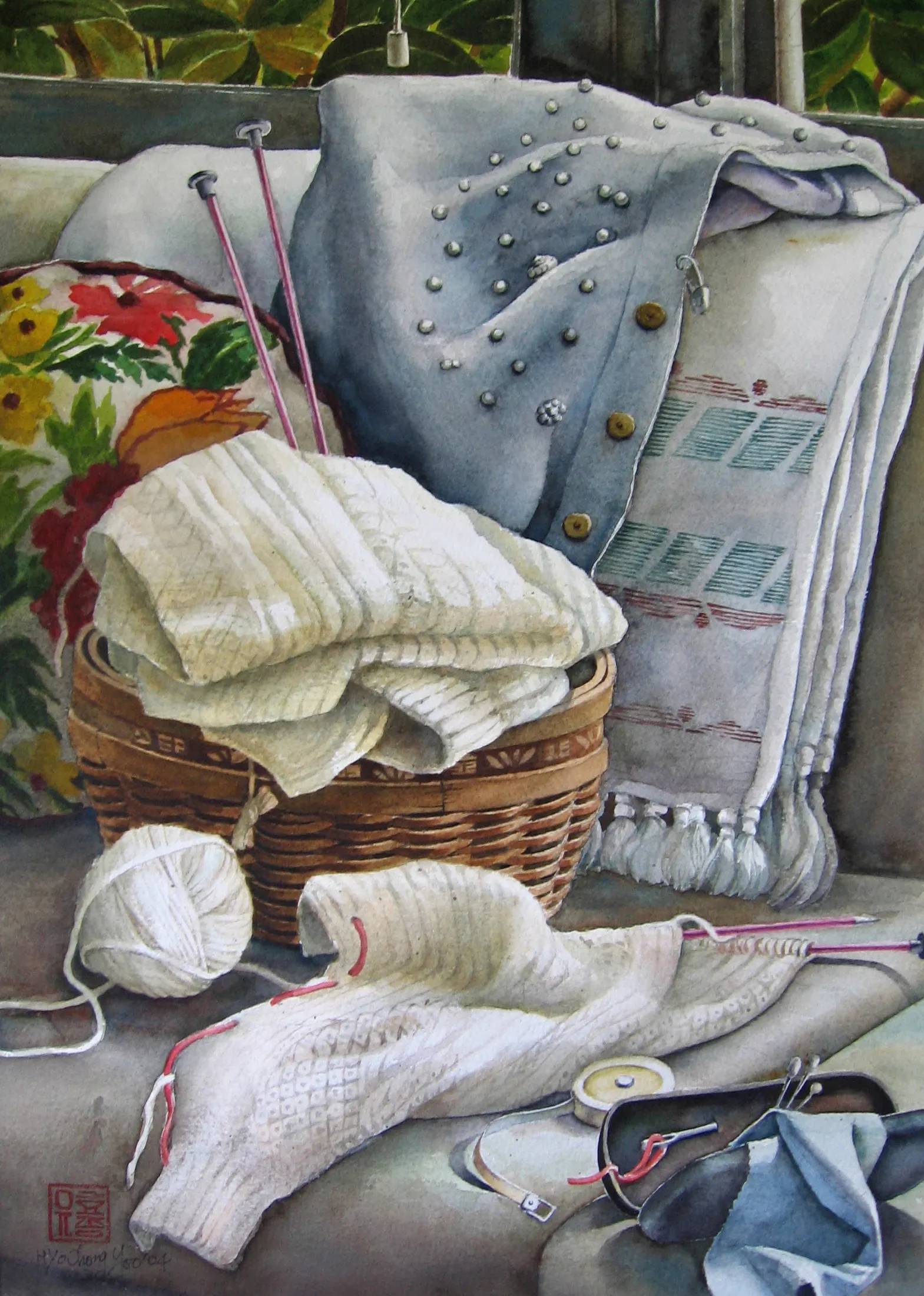
Thread of Her Waiting (그녀의 기다림의 실)
2010s; Watercolor on paper, 24 x 36 in
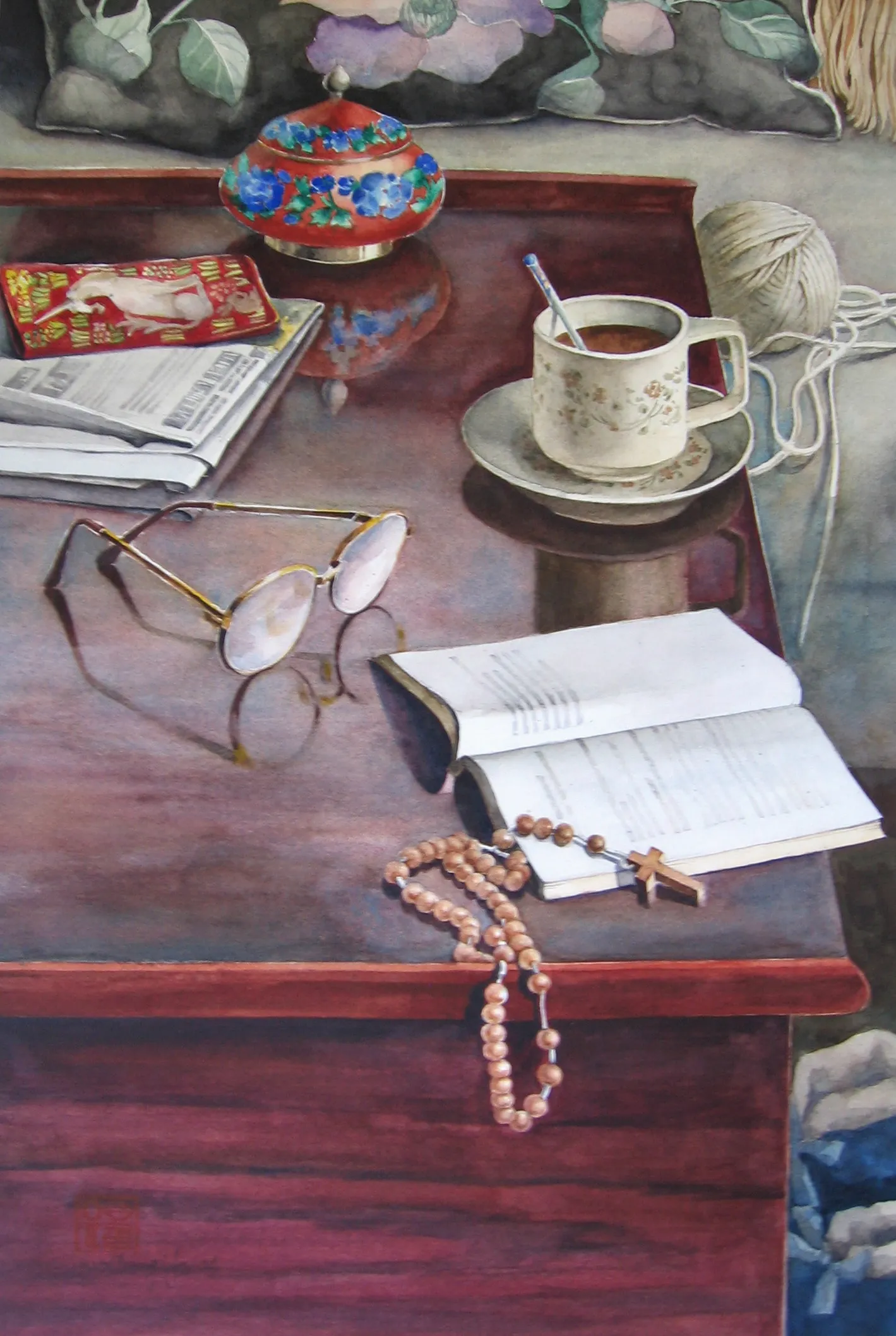
Table of Remembrance (기억의 탁자)
2010s; Watercolor on paper, 24 x 36 in
Later Years & Teaching Legacy
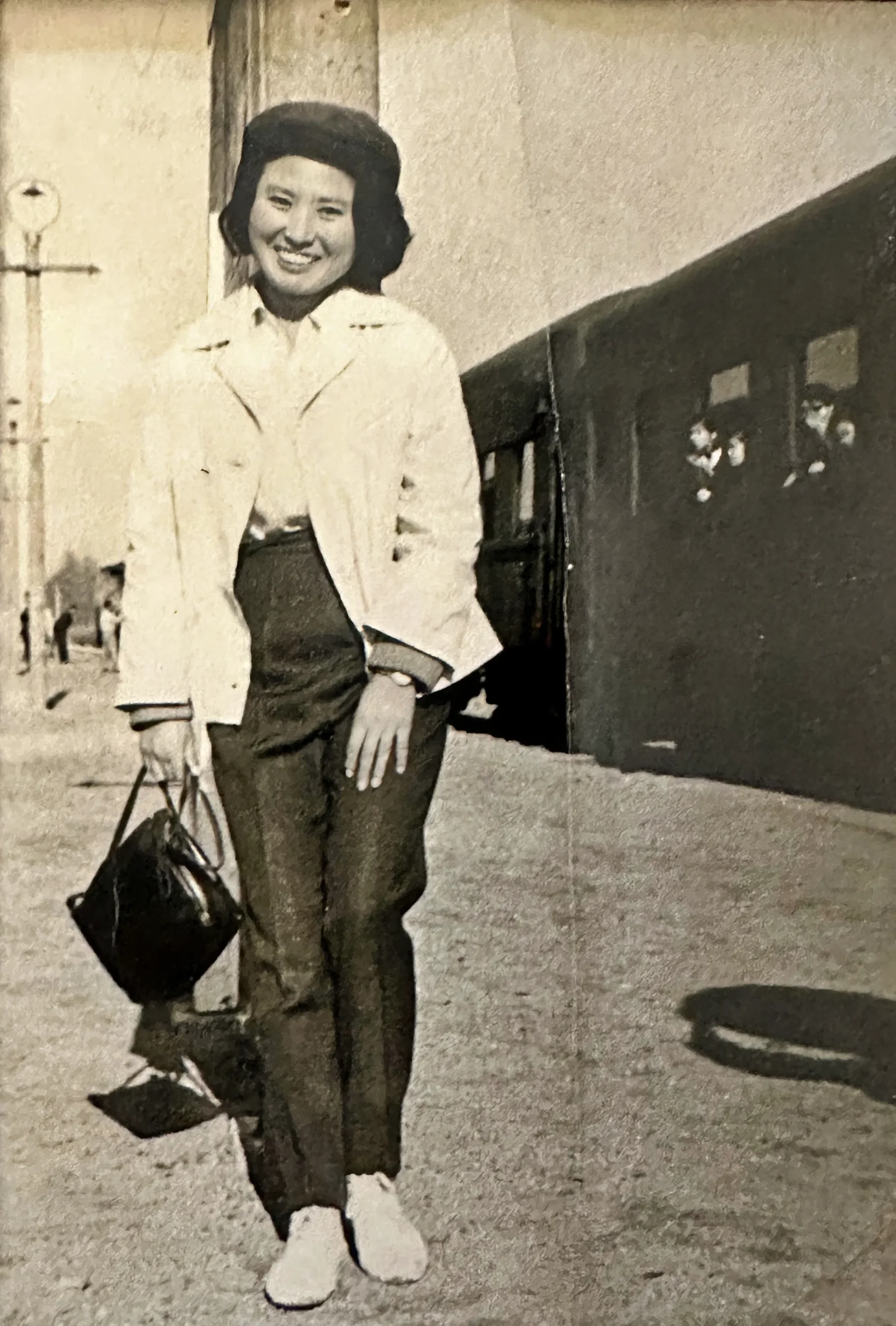
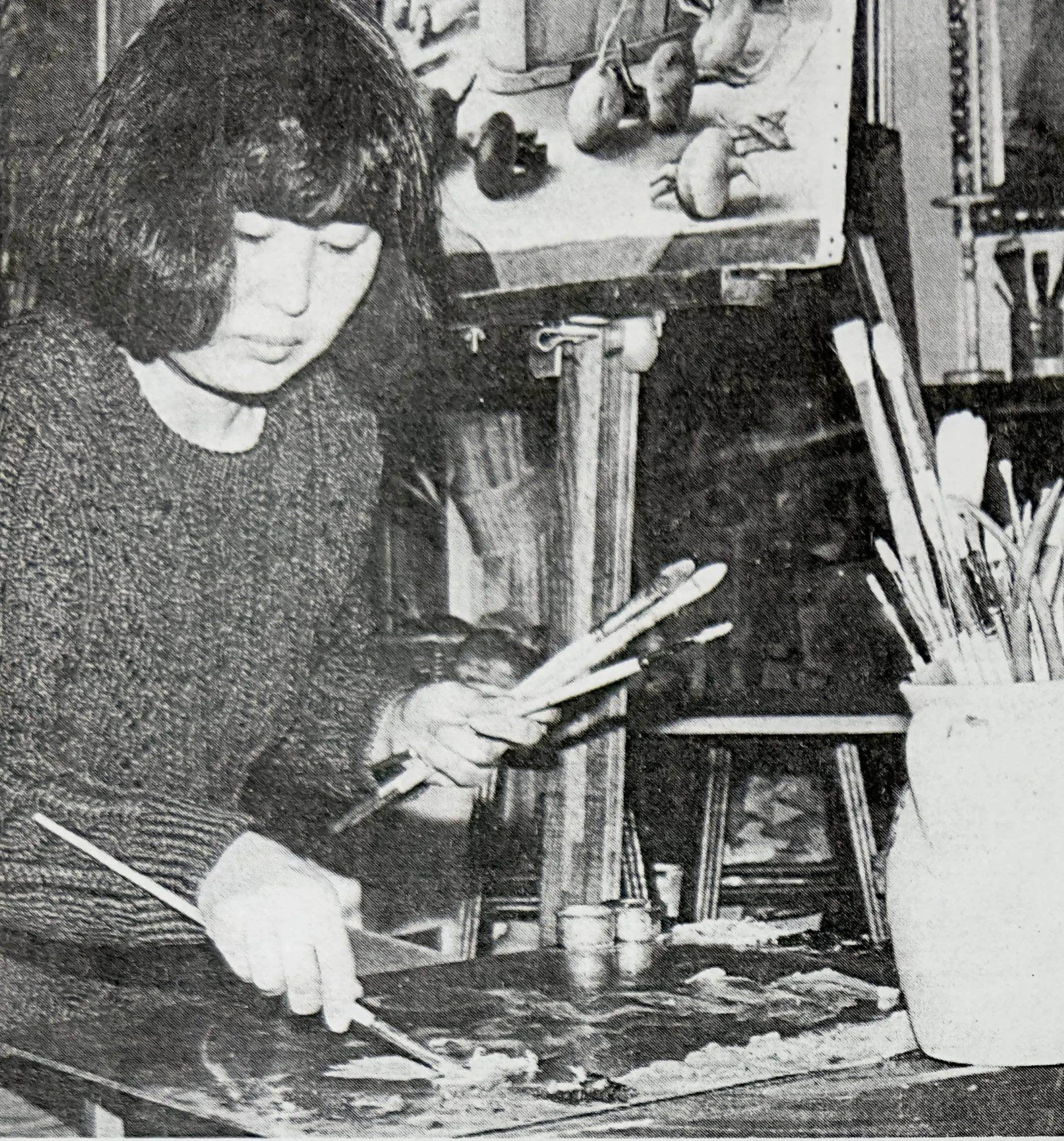
Beyond her studio, Yoo’s influence extended through decades of teaching art at Upsala and Centenary Colleges, continuing the commitment to teaching that began during her early years at Geumran Girls’ Middle School in Korea. Yoo established galleries for her students, led cultural exchanges, and mentored young artists. Beloved as “Emo” (aunt) by students and honored as the “Teacher of the Year” several times at the colleges, Yoo guided her students to find truth in observation. Yoo retired from teaching in 2019 at age 82 and was awarded “Professor Emeritus” from Centenary College.
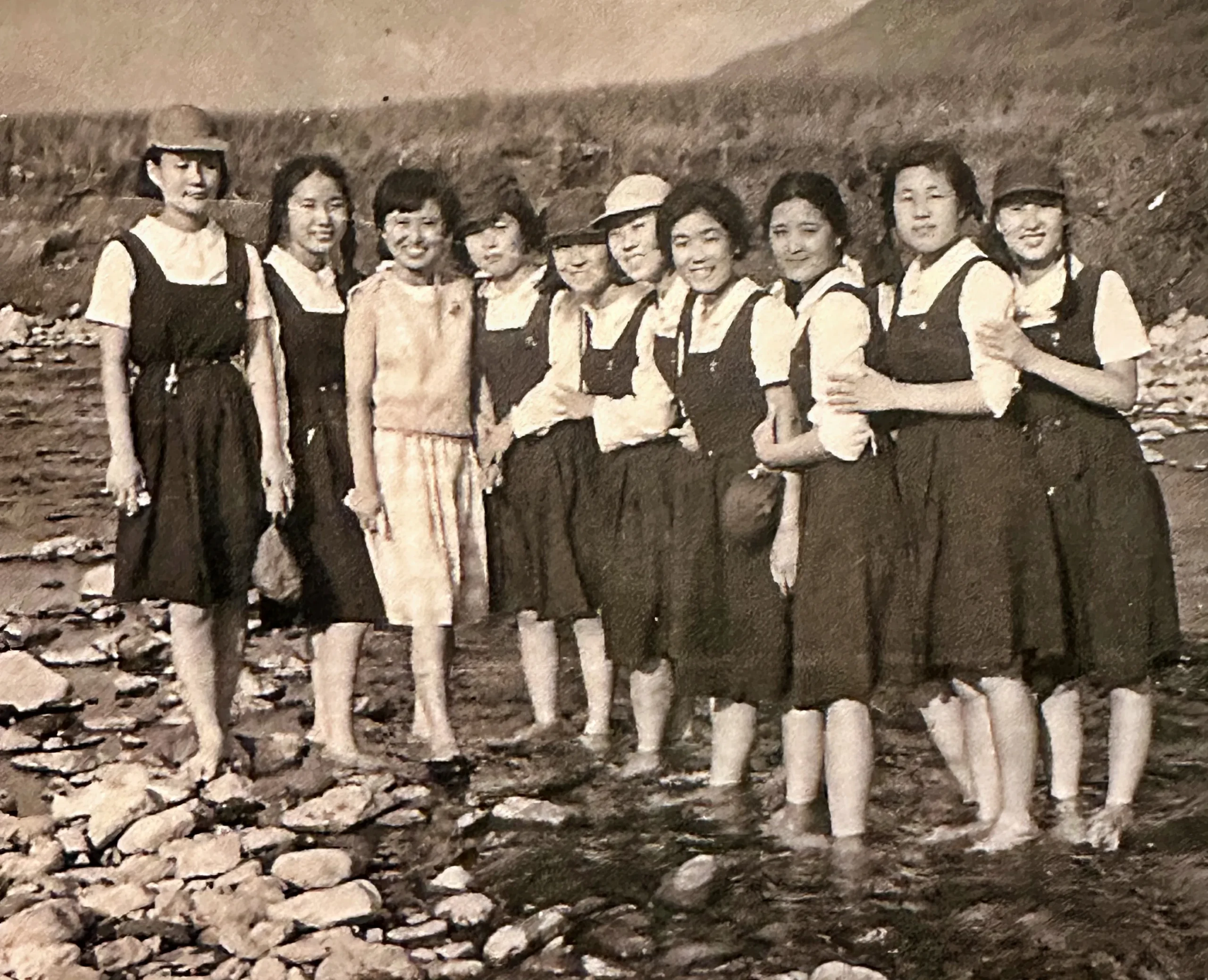
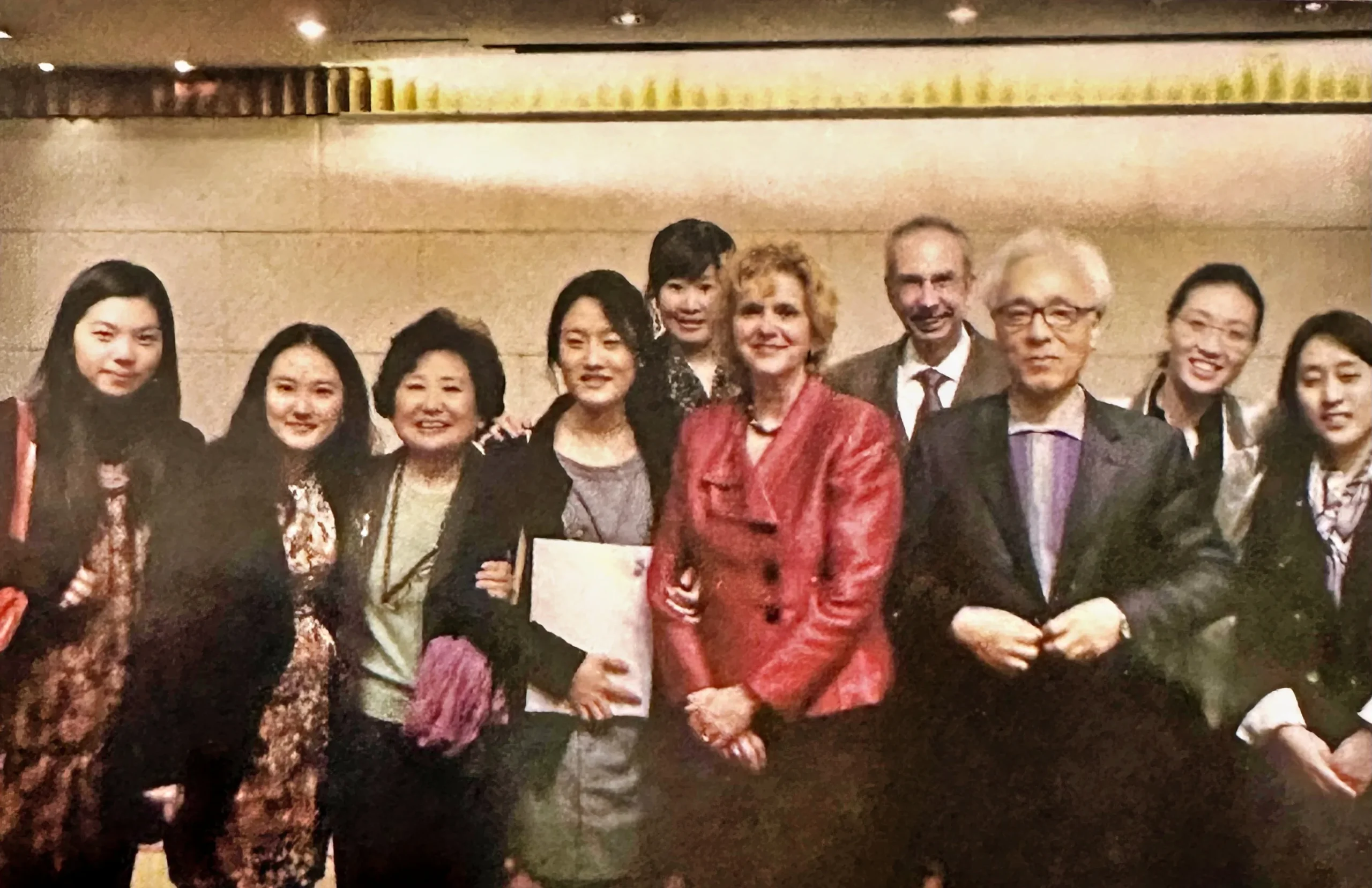
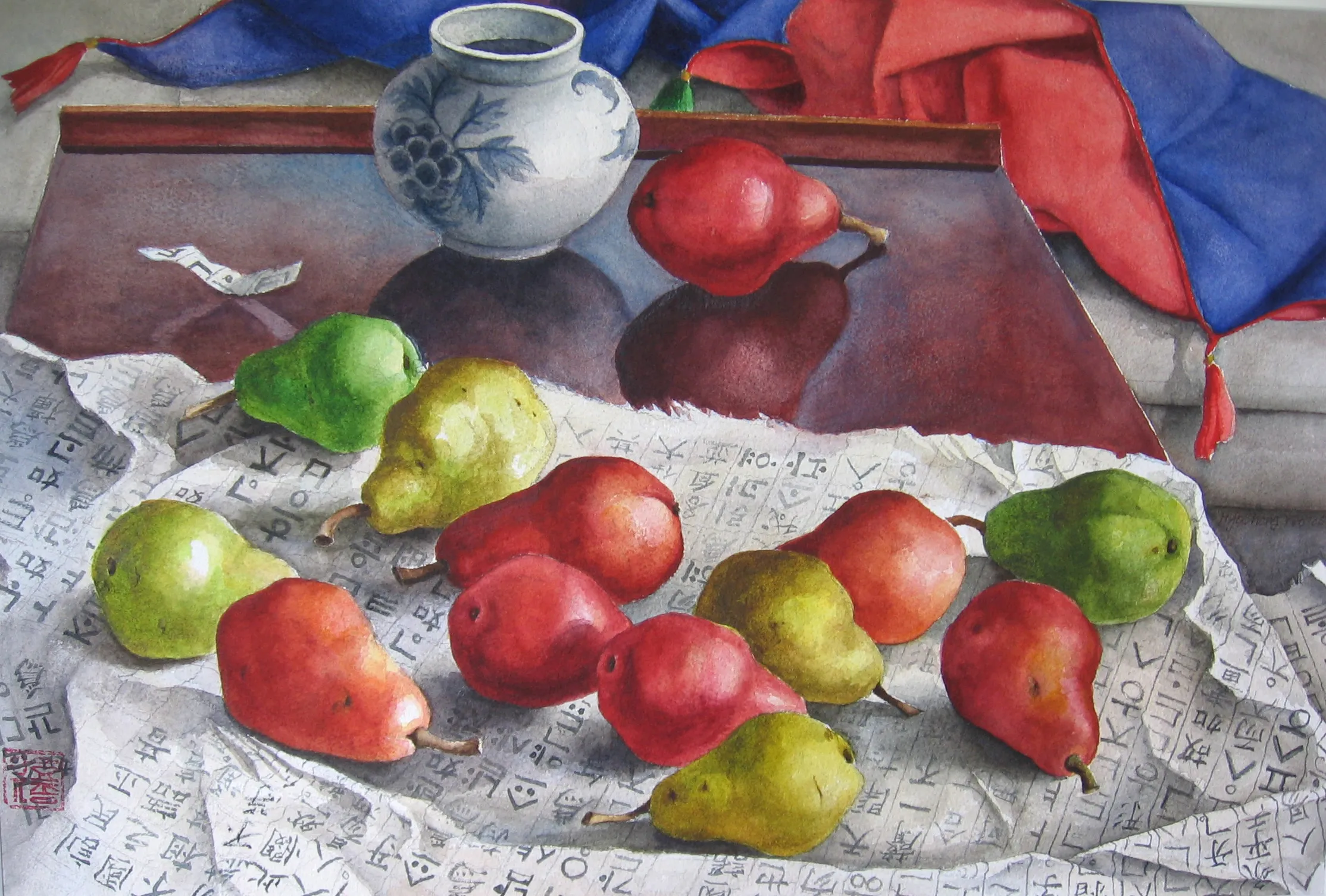
Hyo‑Chong Yoo’s art unites filial love, discipline, and truth. Rooted in her father’s inkstone, refined by Kim In‑Seung’s realism and Western foundation, and immortalized through her mother’s images, her realism is not copying forms but an effort to uncover our original truth and harmony.
“Realism is the most truthful language I know. It does not invent—it reveals. Through realism I can honor what exists, what breathes in front of me. Abstraction may express freedom, but realism gives me clarity. It is a dialogue with life, a search for harmony and moral order. When I paint what is real, I paint what I love.” – Hyo Chong Yoo
Chronology
1937 Born in Hamhung, Hamgyeong Province, Korea.
1957–61 Studies Fine Arts at Ewha Womans University under Kim In‑Seung.
1966 Receives M.F.A. from Ewha Womans University.
1969 Moves to the United States to study at the National Academy of Design.
1978–95 Teaches Art at Upsala College, New Jersey.
1984 First U.S. Solo Exhibition, Upsala College Gallery.
1987 Return Exhibition, Josun Hotel Gallery, Seoul.
1996–2019 Professor, Centenary University, Hackettstown, NJ; later Professor Emeritus.
2011 Exhibits *Affinity* at Grand Palais, Paris.
2019 Retires; continues painting and mentoring artists.
